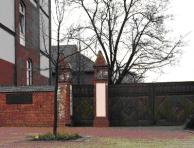

A memorial complex, opened in 2015 and several memorial stones close to the village of Maly Trostenets, about 12 kilometres south-east of Minsk, commemorate those who perished here. Between 1942 and 1944, Maly Trostenets was the site of the largest nazi extermination camp in the occupied parts of the Soviet Union.

Maly Trostenets, 1944, The barbed wire fence of the extermination camp, Belaruski dzyarshaŭny muzey gistoryi Vyalikay Ajtchynnay Vayny

Maly Trostenets, 2015, View of the memorial »Gate of Remembrance«, Stiftung Denkmal
The Belarusian capital of Minsk was occupied by the German Wehrmacht on June 28, 1941. Three weeks later, on July 19, 1941, the German military administration set up a ghetto for the approximately 80,000 Jews living in Minsk. In Maly Trostenets, a village 12 kilometres outside of Minsk, the German occupation authorities took control of the »Karl Marx« kolkhoz - a 250 hectare-large former agricultural estate - to accommodate the security forces and the Wehrmacht stationed in Minsk. Prisoners of war and Jews from the ghetto had to conduct forced labour on the estate. From November 1941 on, transports of Jews from the German Reich arrived in Minsk. In order to make room for them in the ghetto, the chief of security police in Minsk, Erich Ehrlinger, ordered the shooting of several thousand Jews from the ghetto. Many of the shootings took place in the forest of Blagovshchina near Maly Trostenets. Later, between May and October 1942, transports of Jews from the German Reich, including Austria and Bohemia and Moravia, continued to arrive and were sent via Minsk directly to Maly Trostenets where they were immediately shot by members of security police in the forest of Blagovshchina. Beginning June 1942, they also began using »gas vans« to murder Jews.
In October 1943, Sonderkommando 1005 arrived in Maly Trostenets. This special unit, which for the most part consisted of Jewish forced labourers, had been created in order to eliminate traces of the mass murders. The men had to open mass graves and then burn the rotting corpses. Before fleeing from the advancing Red Army, the Germans committed their last mass murder: between June 28 and 30, 1944, members of the security forces shot the last forced labourers and prisoners from Minsk prisons in a barn at Maly Trostenets. When the barn had filled up with 6,500 bodies, they set fire to the building. Three days later, Soviet troops arrived in Maly Trostenets.
In October 1943, Sonderkommando 1005 arrived in Maly Trostenets. This special unit, which for the most part consisted of Jewish forced labourers, had been created in order to eliminate traces of the mass murders. The men had to open mass graves and then burn the rotting corpses. Before fleeing from the advancing Red Army, the Germans committed their last mass murder: between June 28 and 30, 1944, members of the security forces shot the last forced labourers and prisoners from Minsk prisons in a barn at Maly Trostenets. When the barn had filled up with 6,500 bodies, they set fire to the building. Three days later, Soviet troops arrived in Maly Trostenets.
Maly Trostenets, 1944, The barbed wire fence of the extermination camp, Belaruski dzyarshaŭny muzey gistoryi Vyalikay Ajtchynnay Vayny
Maly Trostenets, 2015, View of the memorial »Gate of Remembrance«, Stiftung Denkmal
First and foremost, the SS murdered Jews, partisans, political prisoners Belarusian civilians at Maly Trostenets. The Jews came from the Minsk ghetto or had been deported from the German Reich. The exact number of people murdered at Maly Trostenets is not known: it is estimated that at least 60,000 perished, while official Soviet records spoke of 206,500 victims.

Maly Trostenets, 1944, Members of the Soviet Special Commission examine corpses, Yad Vashem

Maly Trostenets, 2015, Memorial stone in the Blagovshchina Forest, Stiftung Denkmal
For decades, not much was there to commemorate the camp of Maly Trostenez, one of the central sites of the Nazi genocide against European Jews. In 1963, an obelisk was unveiled in considerable distance to the actual historical site. According to its inscription, it commemorates »peaceful Soviet citizens, partisans and prisoners of war, who were shot, tortured and burned by the German fascist intruders«. Like everywhere else in the Soviet Union, the fact most victims of the camp were Jews was not mentioned.
In the 1980s, the last remnants of the camp buildings were removed. Later several memorial stones were set up, for example Blagovshchina forest, at the site where corpses were burned or close to the barn in which the last mass shooting of 6,500 prisoners took place a few days before liberation.
In 2015, the former premises of the camp were completely renewed at the initiative of the government in Minsk. The central element of the new memorial complex is the »Gate of Memory« – two 15 meter high stelae, on which figures are to be seen behind barbed wire. A »Path of Memory« leads to the statue, on the sides of which memorial stones remember the victims of other former Nazi killing sites on the territory of Belarus. Other memorial stones remember the victims and inform on the history of the camp in Belarusian, Russian and English.
A new memorial complex was opened in June 2018 in the Blagovshchina Forest. The inauguration ceremony was attended by the presidents of Belarus, Germany and Austria. For the mos part, the architectural plans for the new memorial complex were made by the late Belarusian architect Leonid Levin (1936-2014). Five stylized freight train carriages symbolize the last path taken by the victims to their deaths. Large grave fields indicate the 34 mass graves found on the historical site.
In November 2016, a German-Belarusian travelling exhibition with the title »Mal Trostenets. History and Remembrance« was opened. The Foundation Memorial to the Murdered Jews of Europe had been one of the leading project partners in this international cooperation project.
In the 1980s, the last remnants of the camp buildings were removed. Later several memorial stones were set up, for example Blagovshchina forest, at the site where corpses were burned or close to the barn in which the last mass shooting of 6,500 prisoners took place a few days before liberation.
In 2015, the former premises of the camp were completely renewed at the initiative of the government in Minsk. The central element of the new memorial complex is the »Gate of Memory« – two 15 meter high stelae, on which figures are to be seen behind barbed wire. A »Path of Memory« leads to the statue, on the sides of which memorial stones remember the victims of other former Nazi killing sites on the territory of Belarus. Other memorial stones remember the victims and inform on the history of the camp in Belarusian, Russian and English.
A new memorial complex was opened in June 2018 in the Blagovshchina Forest. The inauguration ceremony was attended by the presidents of Belarus, Germany and Austria. For the mos part, the architectural plans for the new memorial complex were made by the late Belarusian architect Leonid Levin (1936-2014). Five stylized freight train carriages symbolize the last path taken by the victims to their deaths. Large grave fields indicate the 34 mass graves found on the historical site.
In November 2016, a German-Belarusian travelling exhibition with the title »Mal Trostenets. History and Remembrance« was opened. The Foundation Memorial to the Murdered Jews of Europe had been one of the leading project partners in this international cooperation project.

Maly Trostenez, 2015, »Path of Remembrance« on the former camp premises, IBB Minsk

Malyj Trostenez, 2018, Symbolical train carriages remind of the last path of the victims in Blagovshchina forest, Galina Levina

Maly Trostenets, 2010, Monument at the site of the last mass shooting in June 1944, Sabine Erbstößer

Maly Trostenets, 2010, Monument at the site on which corpses were burned, Martina Berner

Maly Trostenets, 2010, In the Blagovshchina forest, Martina Berner

Maly Trostenets, 2015, Detailed view of the memorial »Gate of Remembrance«, IBB Minsk

Maly Trostenets, Memorial stone on the former premises of the camp, Stiftung Denkmal

Maly Trostenets, Obelisk from 1963, Stiftung Denkmal

Maly Trostenets, 2015, Memorial stone with information on Nazi killings sites in Belarus, Stiftung Denkmal

Maly Trostenets, 2015, Information on the memorial, Stiftung Denkmal

Malyj Trostenez, 2018, View of the memorial complex in Blagovshchina forest, Galina Levina

Malyj Trostenez, 2018, View of the memorial complex in Blagovshchina forest, Galina Levina
- Name
- Memorialnyj kompleks lager smerti Malyj Trostenez
- Address
-
ul. Selitskogo
220075 Minsk - Phone
- +375 17 380 37 17
- Fax
- +375 17 380 37 17
- Web
- http://www.gwminsk.com/
- info.gwminsk@ibb.by
- Open
- The monuments are accessible at all times.