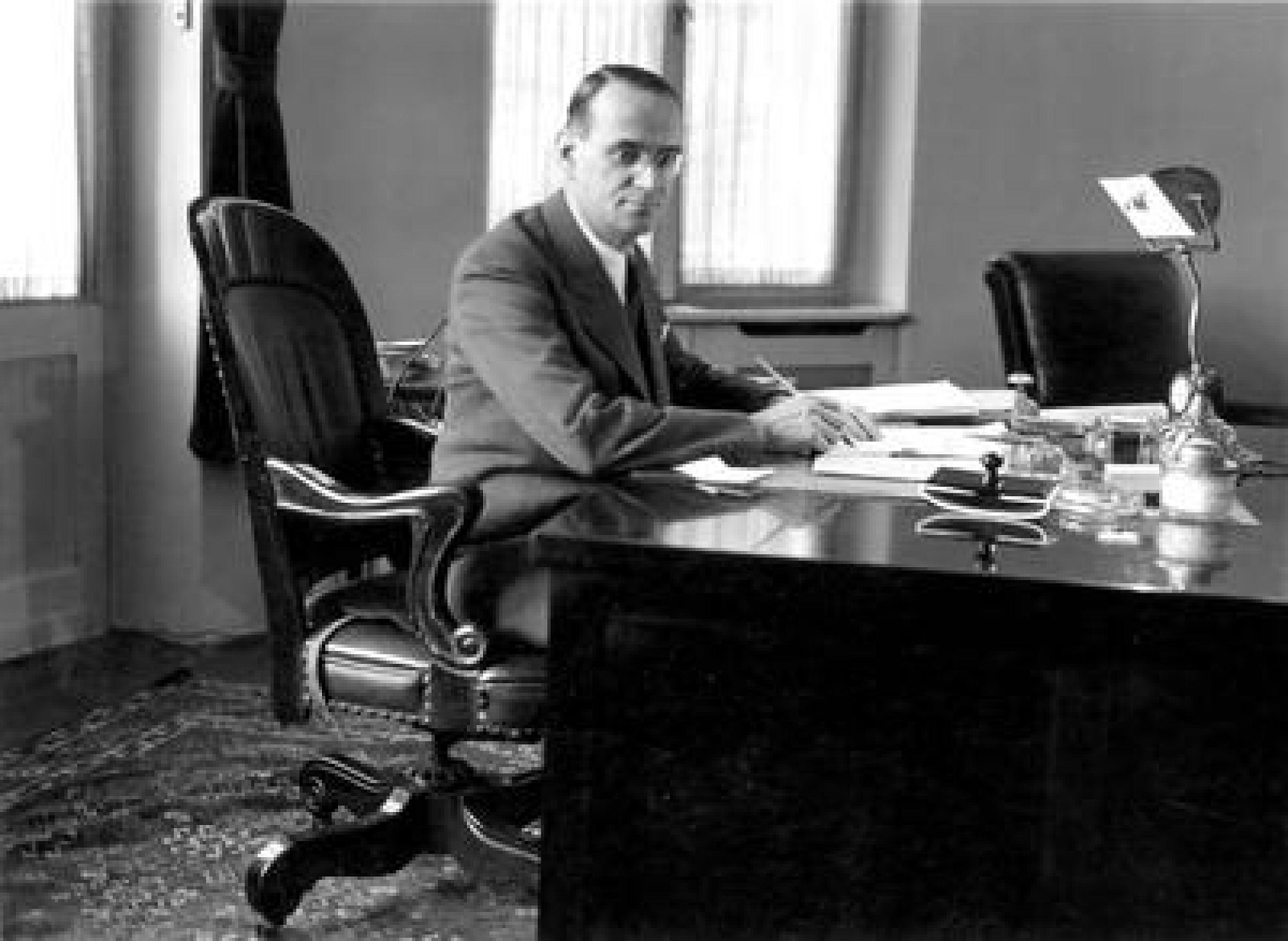
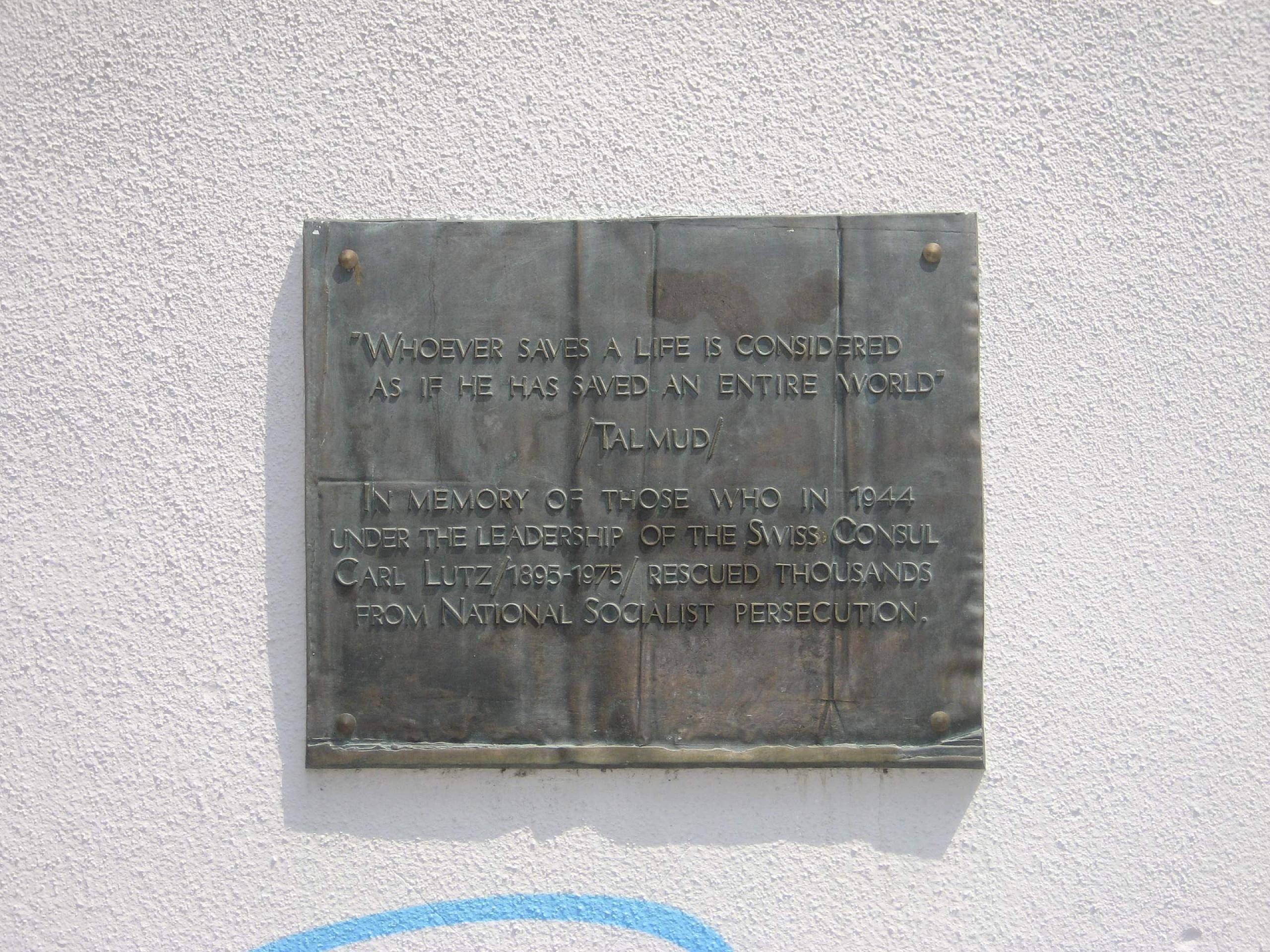
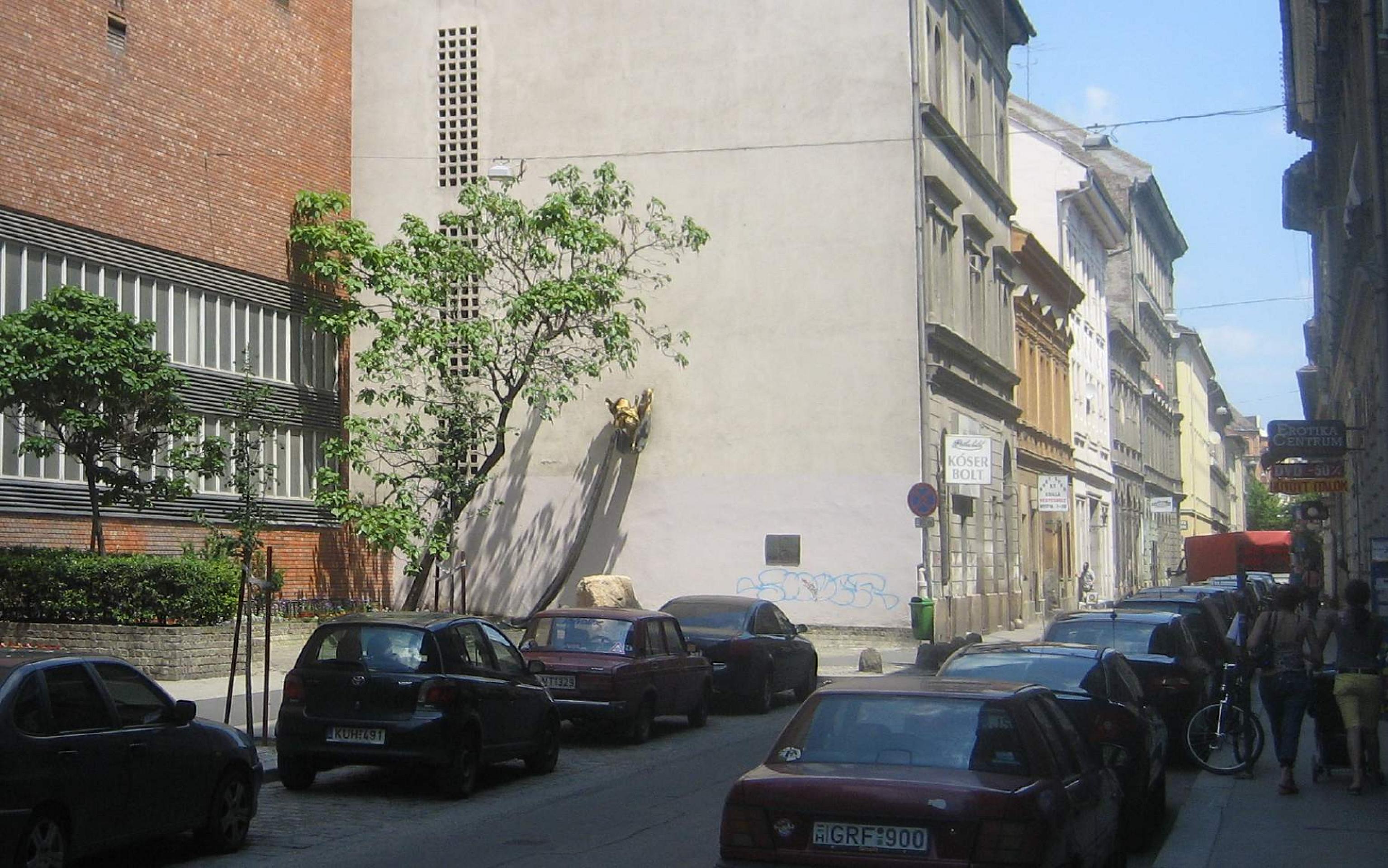
During the war, Swiss diplomat Carl Lutz (1895-1975) helped save tens of thousands of Jews in Budapest from persecution and deportation. Located on the area of the former Budapest ghetto is a monument dedicated to his memory.
History
Neutral Switzerland represented the interests of citizens from several states which had since 1941 been at war with Hungary, including Great Britain and the United States. From the beginning of 1942 on, Carl Lutz led a special department for the protection of these citizens as vice-consul at the Swiss embassy in Budapest. Deliberately exceeding his authority, Lutz issued tens of thousands of Jews protective letters, which were to shield them from deportation and persecution.
Moreover, he was involved in helping Jews emigrate to Palestine, which was at the time under British mandate. Lutz closely worked together with the Zionist »Jewish Agency for Palestine«, led by Moshe (Miklós) Krausz. This organisation was responsible for distributing emigration papers for Palestine.
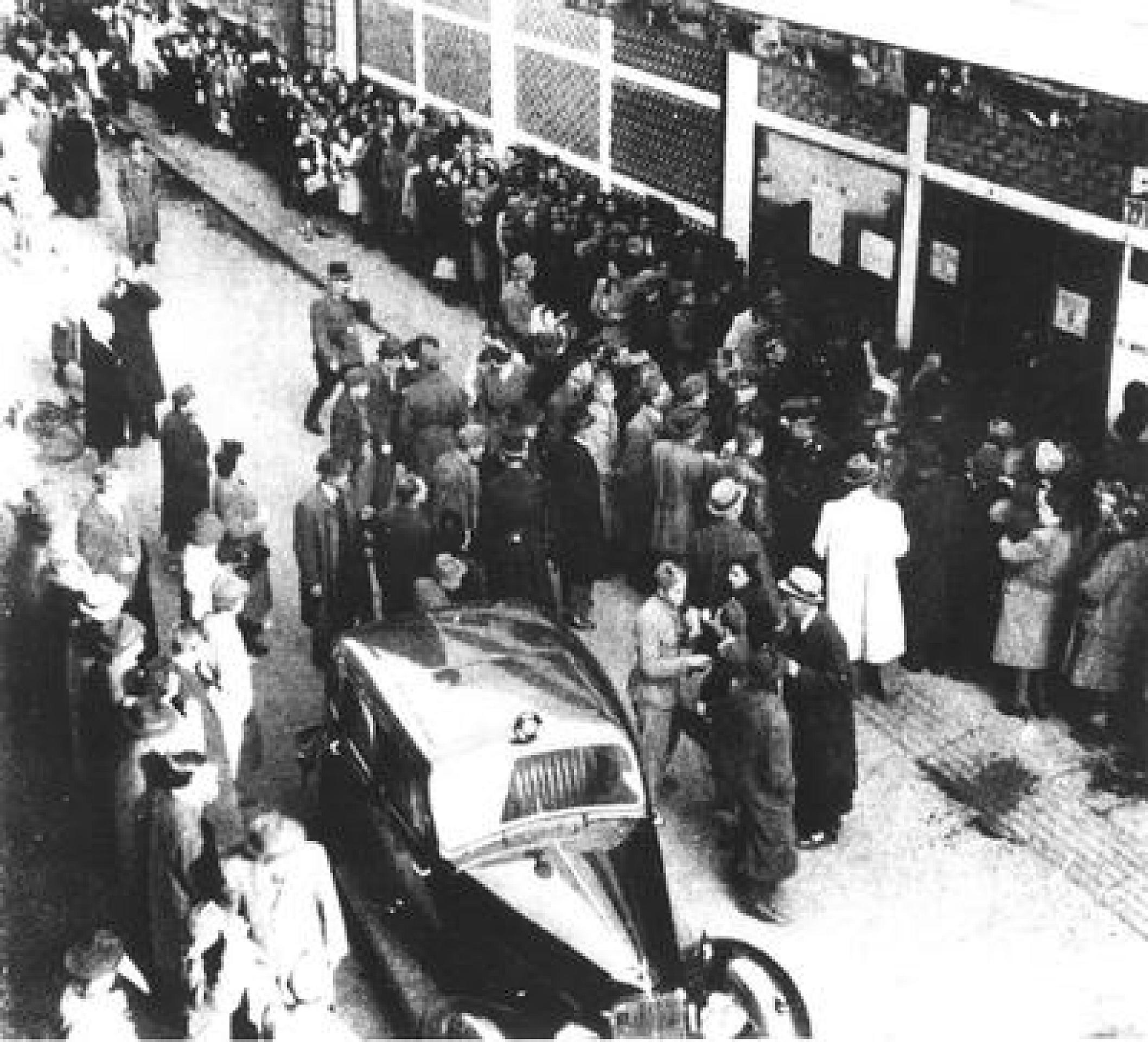
When the German Wehrmacht invaded Hungary on March 19, 1944, Lutz placed the »Jewish Agency« under the protection of the Swiss embassy. The Agency moved into the »Glass House« in Vadász Street 29. Lutz and his helpers did all they could in order to issue as many so-called protective letters and protective passports as they could. Carl Lutz took advantage of the fact that the Hungarian government had – due to pressure from abroad – agreed to allow 8,000 children and youths to emigrate to Palestine, and that these had been in possession of Swiss documents before the German invasion. Lutz and Krausz interpreted the decree to mean that not only individuals holding these documents but their entire families would be allowed to emigrate, thereby placing tens of thousands of people under their protection.
After the establishment of the Budapest ghetto in the winter of 1944, Lutz established numerous »safe houses« under Swiss protection and tried to arrange the best possible conditions for the Jews who sought refuge there.
Victims
About 119,000 Jews were liberated in Budapest when the Soviet army took the city. It is neither known nor possible to determine how many were saved due to the efforts made by Carl Lutz. Several sources speak of up to 62,000 lives saved.
Following defeat in the First World War and the collapse of the Austro-Hungarian Empire, Hungary had to surrender two thirds of its territory and sixty percent of its population to its neighbours in 1920. The trauma caused by these losses led Hungary, under the leadership of Miklós Horthy (1868–1957), to gradually ally itself with Nazi Germany from 1937 onwards. Between 1938 and 1941 Hungary managed to almost double its territory in several stages of border revisions. Faced with the advance of the Red Army the country began to distanc itself from Nazi Germany and was therefore occupied by the Wehrmacht in March 1944. Miklós Horthy retained his position as head of state. Almost immediately after the invasion and with the assistance of Hungarian authorities, the SS began to deport Jews to the Auschwitz extermination camp, something that Hungary had refused to do up to then, despite having introduced anti-Jewish legislation. Of the 825,000 Jews from »Greater Hungary« the number murdered in Auschwitz stands at way over half a million. Up to 300,000 of these Jews came from the regions of what is today’s Hungary. In addition, around 140,000 soldiers along with some 170,000 non-Jewish civilians perished during the Second World War.
After 1945 Hungary was in the Soviet sphere of influence. Up to 1989, official commemorations in Hungary did not remember the war but rather its end as the »liberation from fascism«. However, for the majority of the population 1945 was the start of a long period of repression. For many Hungarians, memory of the national uprising in 1956 that was crushed by the Soviets overshadows that of the Second World War. Following the uprising the war was viewed as the inglorious prelude to the suffering under communist rule. At the same time, there were many state monuments celebrating »Hungarian-Soviet friendship«. During the communist period there was no official remembrance of those who had died during the war on the front, at home and during the genocide, nor were there any Holocaust memorial sites outside of Jewish institutions. The only related site was the Jewish Museum in Budapest, founded in 1932 and reopened in 1947. In 1985 the Jewish community in Budapest opened a »Raoul Wallenberg Memorial Park« alongside the large synagogue located on the edge of the former ghetto. A state monument to Raoul Wallenberg (*1912–?) was inaugurated in 1987 in connection with a visit by the communist head of state János Kádár (1912–1989) to Sweden. Wallenberg, a Swedish diplomat, saved thousands of Budapest Jews. He was deported by the Soviet occupation force in 1945 and since then has been missing, presumed dead. This monument marked a turnaround in the decades of silence regarding the Holocaust. Only since the new millennium have numerous Holocaust memorials and memorial sites emerged in Hungary. These include the »Shoes on the Danube Promenade« in Budapest, inaugurated on 16 April 2005, the date of the Hungarian Holocaust Remembrance Day introduced in 2000. This memorial remembers the murder of up to 20,000 Jews from the Budapest ghetto in January 1945 by the »Arrow Cross«, a right-wing extremist party that had assumed power in Hungary on 15 October 1944. A national Holocaust Museum was opened in the capital in 2004. However, there are still very few memorials to other victims. Symptomatic of the way in which post-communist Hungary has dealt with its 20th century past is the fiercely debated »House of Terror«, opened in the centre of Budapest in 2002, which deals with the history of »both totalitarian dictatorships«. The involvement of Hungarians in the deportation of their fellow Jewish citizens often recedes into the background.
Remembrance
For a long time after World War II, the deeds of Carl Lutz were forgotten. His reception in Switzerland was more than cool; he was accused of having exceeded his authority as a diplomat. In 1965, Yad Vashem awarded him the medal of the »Righteous Among the Nations«.
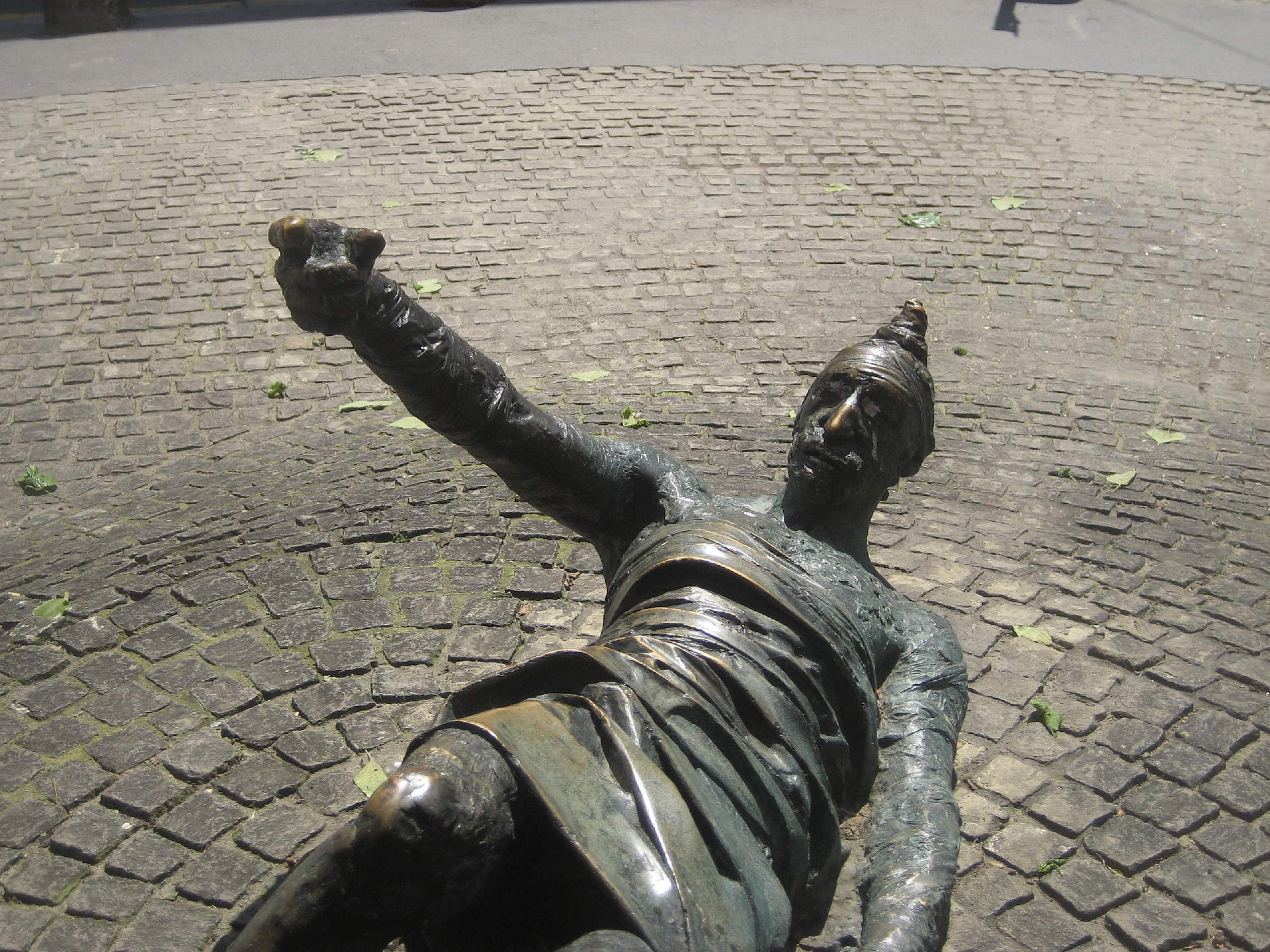
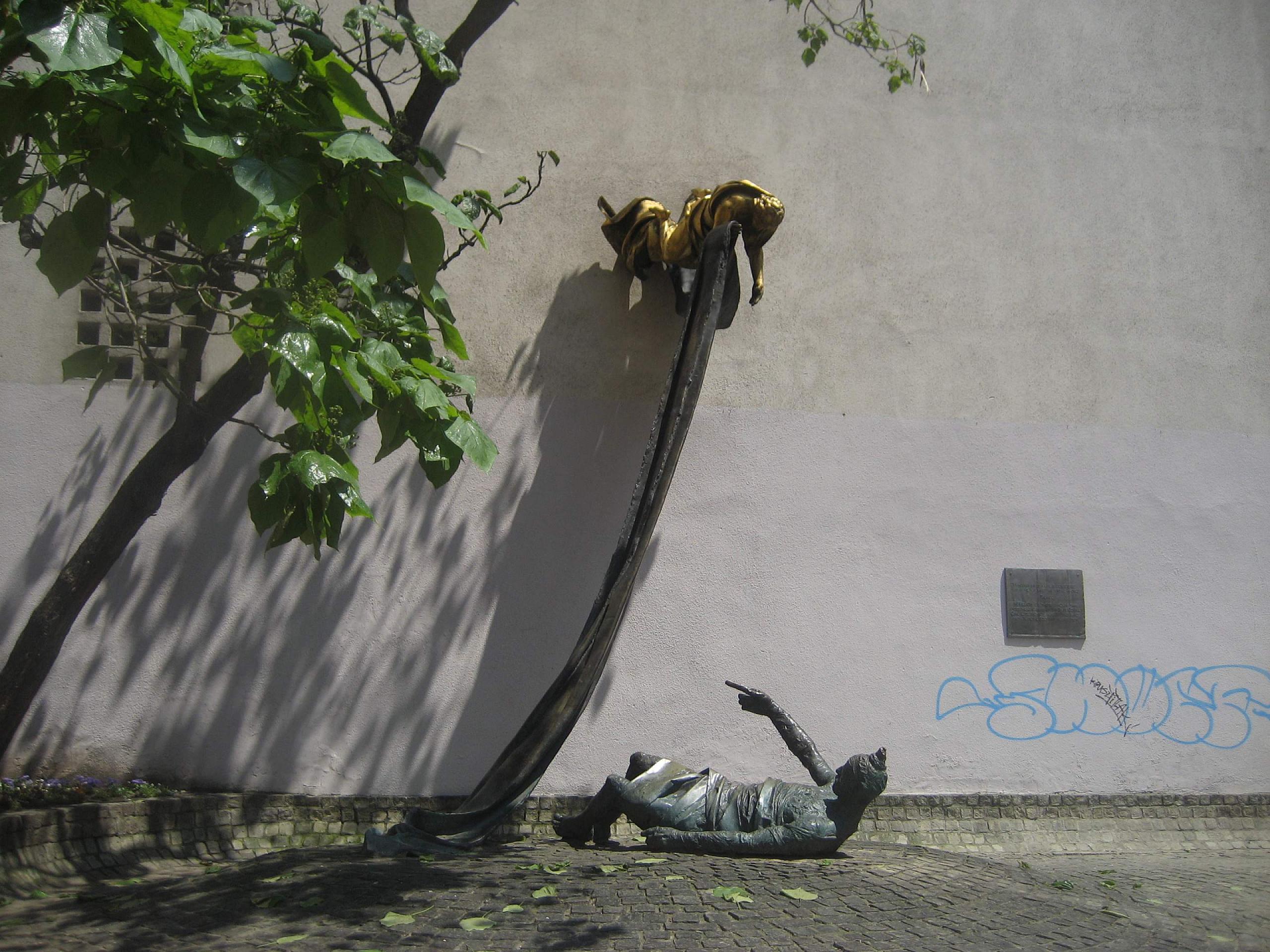
The monument by sculptor Tamás Szabó was set up in 1991 in direct vicinity of one of the former entrances to the Budapest ghetto.
The Foundation Carl Lutz with its aim to keep the memory of Carl Lutz and his rescue operations alive, opened a memorial room in the former »Glass House« in 2005.