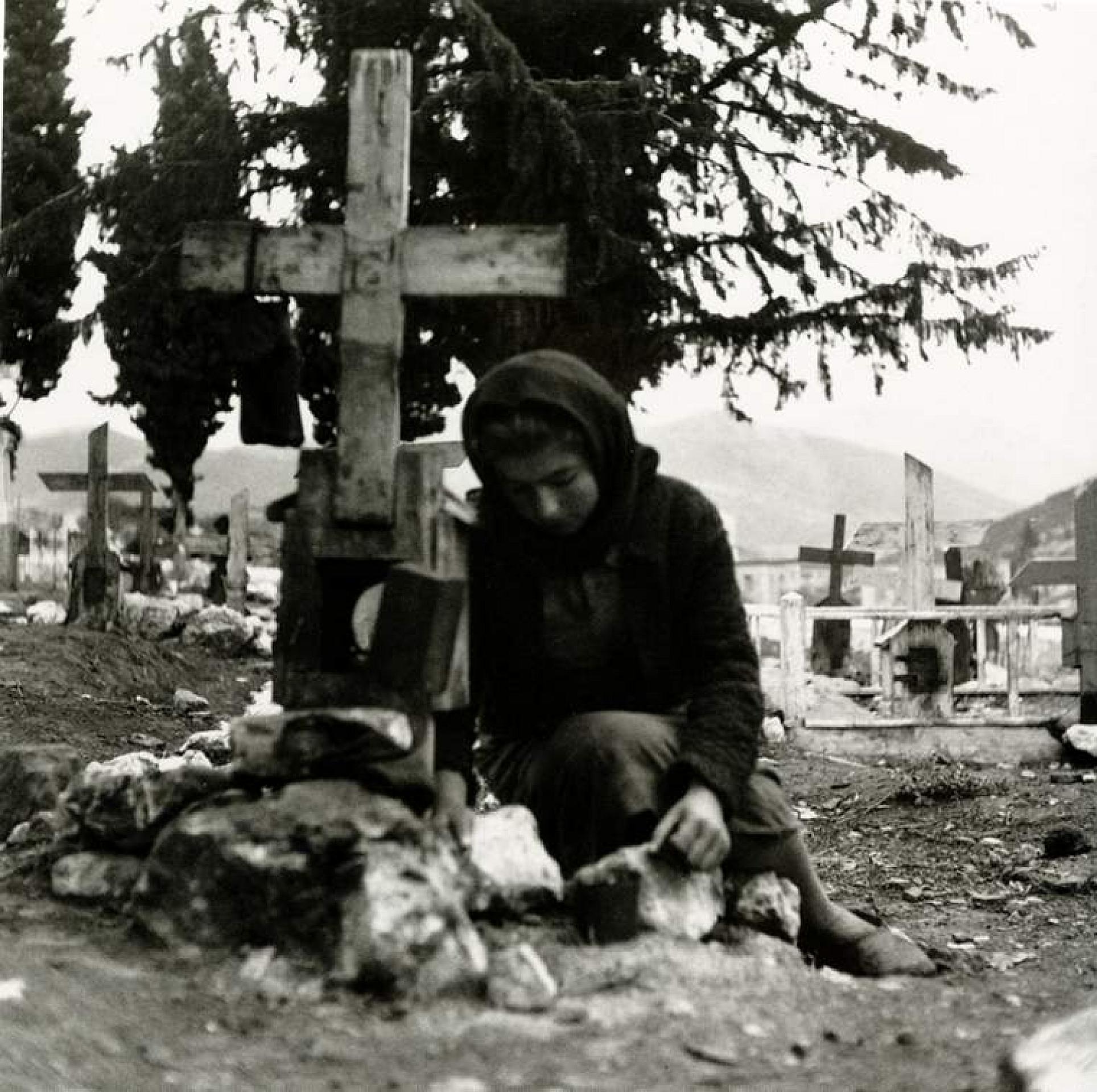
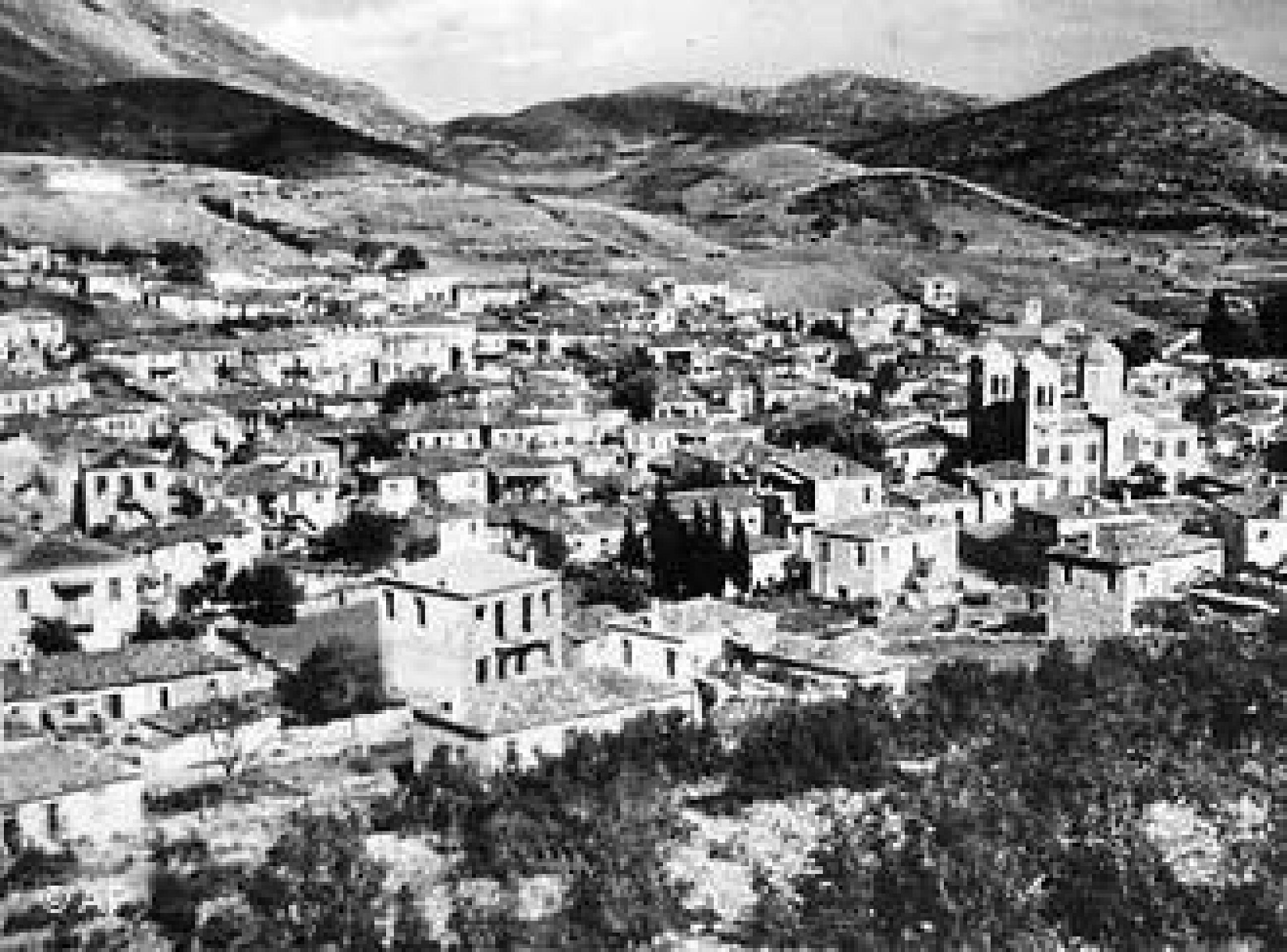
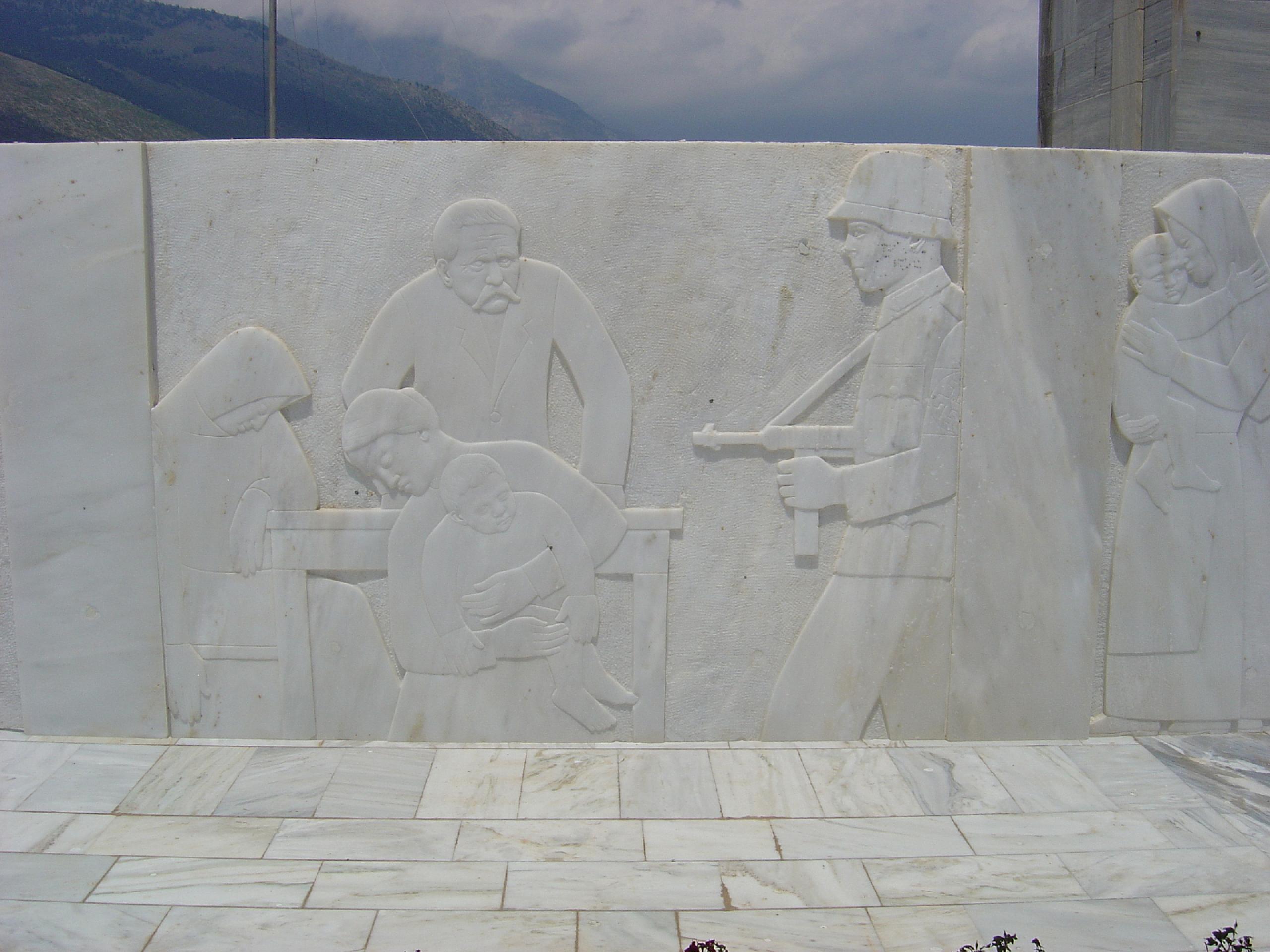
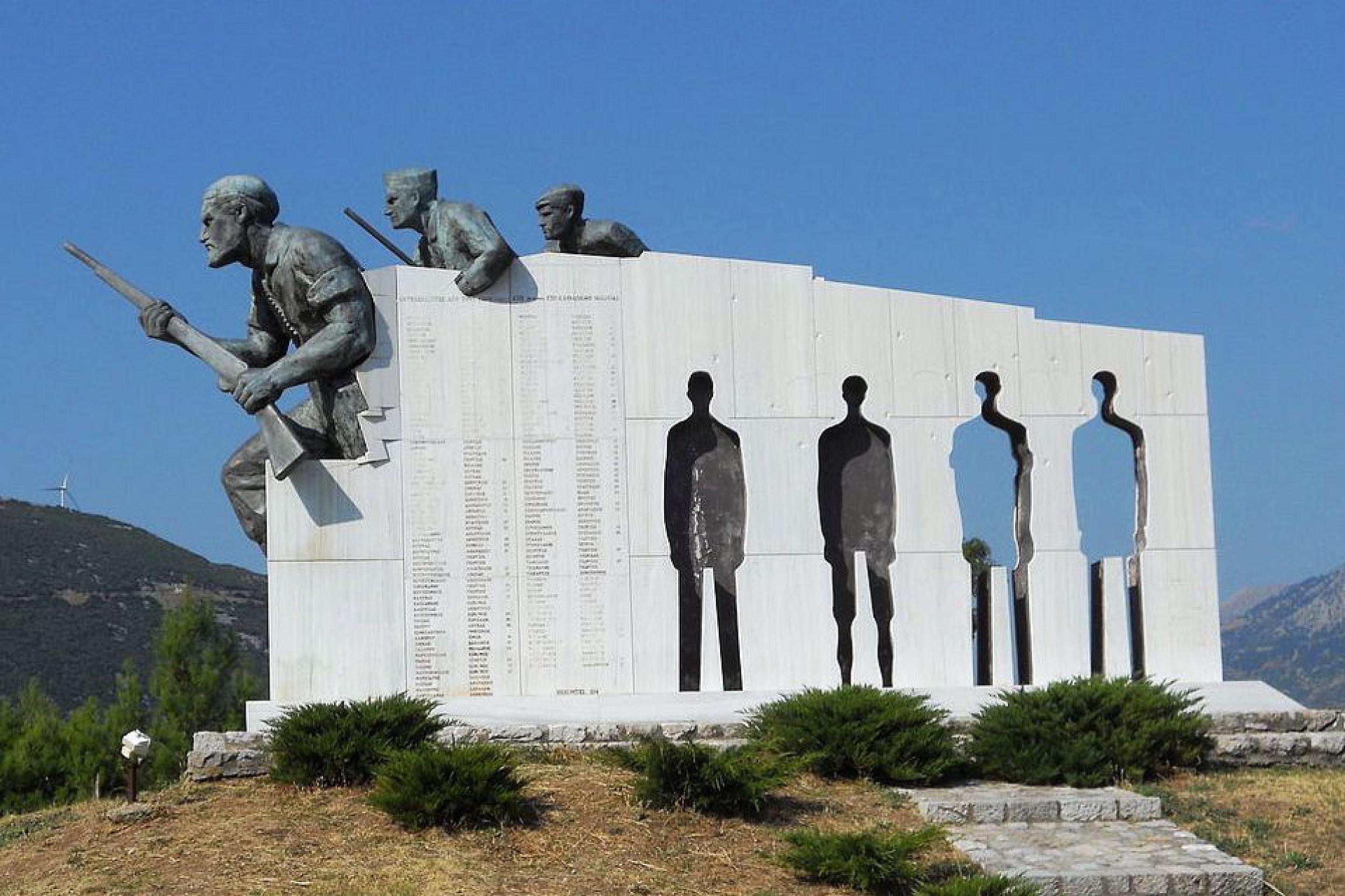
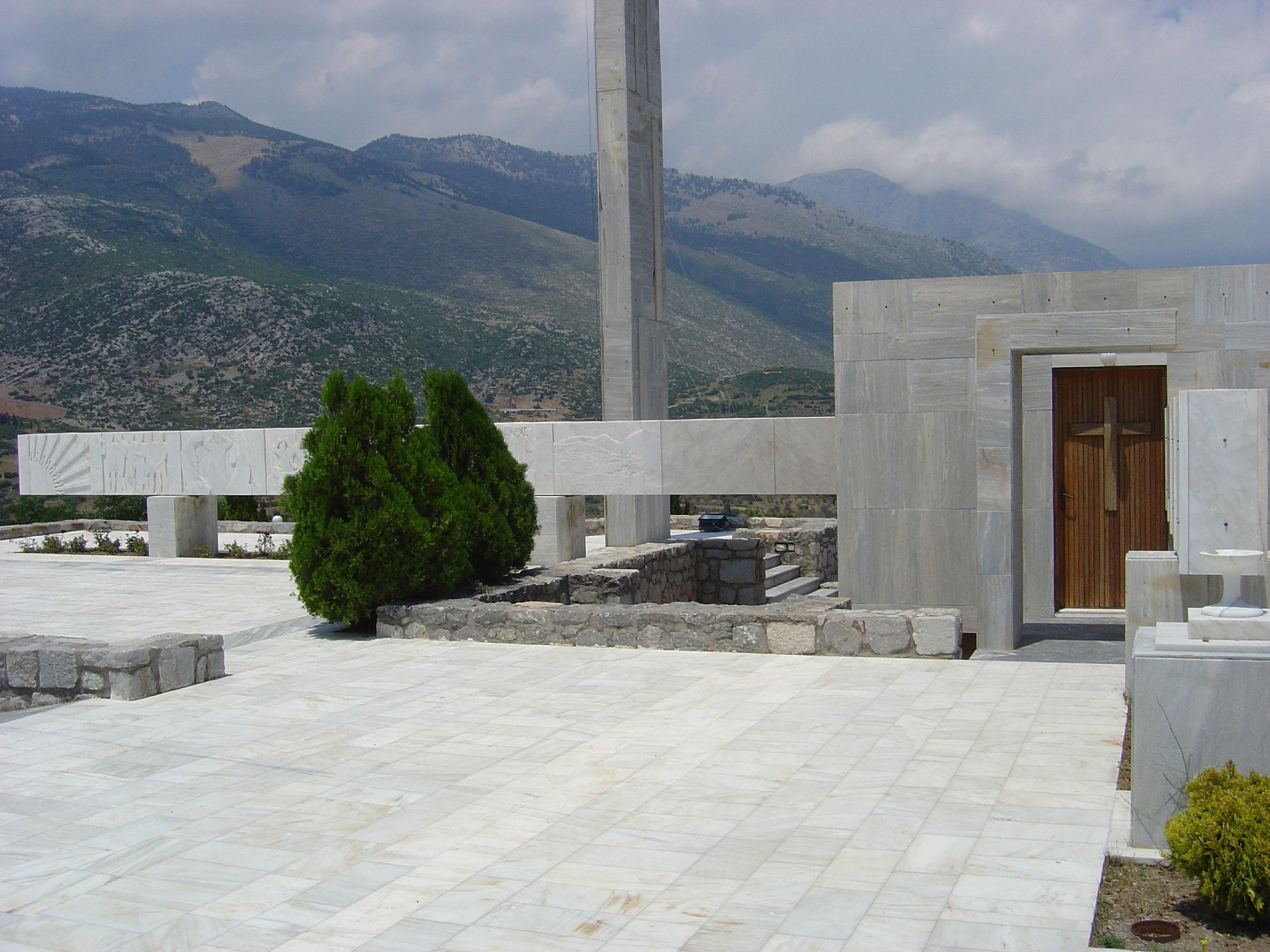
A memorial located on a hilltop overlooking the village of Distomo commemorates the massacre that took place here on June 10, 1944. Members of an SS unit killed almost all of the village residents on that day in a »retaliation operation«.
History
The central Greek region of Boeotia was under German occupation from April 1941 on. Beginning 1944, partisan attacks of the Greek People's Liberation Army (ELAS) on German units became more and more frequent in the region. The German troops retaliated by repressing the civilian population. Greek hostages were executed for each killed soldier, and entire townships were burned down. On June 10, 1944, a reconnaissance unit of the 4th SS Police Panzergrenadier Division was ambushed by partisans not far from the village of Distomo. Several soldiers were killed or injured. That same day, unit commander SS-Hauptsturmführer Fritz Lautenbach single-handedly and without authorisation ordered »retaliation« on the village of Distomo. Towards the evening, the unit entered the village and massacred civilians. The soldiers were particularly brutal in their conduct. After the killings, the soldiers set fire to the houses. Lautenbach justified the haphazard »sanctions« in a report to his superior. He claimed his unit had been fired at from machine guns and mortars by the village residents.
Victims
218 residents of Distomo died in the massacre of June 10, 1944. There were many women, children and elderly people among the victims.
The Wehrmacht invaded the Kingdom of Greece in April 1941. The country was divided up between the Third Reich and its Axis allies Italy and Bulgaria. The occupying powers exploited Greece’s agricultural resources as well as the country’s limited industrial capacity. This resulted in a famine in the winter of 1941-42, which probably claimed the lives of over 100,000 Greeks. Jewish life in occupied Greece was dominated by expropriation, public abuse, arrests, murder and forced labour. Between March 15 and mid-August 1943, around 46,000 Jews were deported in 19 transports from Thessaloniki to the Auschwitz-Birkenau and Treblinka extermination camps. These transports were organised by an SS special commando with the support of the local military administration. At the beginning of March 1943, the Bulgarian occupation authorities in the Greek province of Thrace had already arrested over 4,000 Jews, who were subsequently deported to Treblinka by the SS. Following the capitulation of Italy in autumn 1943, the Wehrmacht advanced to the Italian-occupied part of Greece. In March 1944, the SS and locals deported over 8,500 Jews from Athens, Ionnina and Rhodes to Auschwitz-Birkenau. Italy had previously refused to deport these Jews. Around 59,000 Greek Jews were murdered in the Holocaust.
The German occupation regime met with growing Greek resistance. The Wehrmacht responded in 1943-44 with numerous brutal attacks, reprisals and mass shootings. Entire villages were destroyed, for example the villages of Kalavrita and Distimo. Over 100,000 Greek civilians are believed to have died in the process.
The period from 1944, whilst Greece was still occupied by Germany, saw conflict between right-wing royalists and left-wing communist groups in the country. These conflicts escalated into a civil war from 1946-49. The royalists won this war with the support of Great Britain and the USA and adopted a strict anti-communist approach. Faced with a likely left-wing election victory in 1967, the military staged a putsch, seized power, and governed the country for the next seven years. The left-wing’s role in the resistance during the Second World War was only acknowledged following Greek accession to the European Economic Community in 1981. With the fall of communism in 1990-91 the divisions in Greek memory were finally overcome, allowing a confrontation with the 1946-49 civil war.
To a large extent, the Greek culture of memory continues to be dominated by remembrance of the resistance against the Germans. Memorial inscriptions often use the term »Holocaust« to refer to the murder of the civilian population, for example the »Holocaust of Kalavrita«. For a long time it was left to the Jewish community to remember the 85 percent of Greek Jews who were murdered in the Holocaust. Until 1997, the country’s only Holocaust memorial was to be found in the Jewish cemetery in Thessaloniki, the town with the largest Jewish community in Greece before the war. A Holocaust memorial was inaugurated in the centre of Saloniki in 1997 in conjunction with the ceremonies marking the town’s status as European City of Culture that year. In 2005, the memorial was moved to another site in the city. In 2010, a new holocaust memorial was inaugurated in Athens as well. Currently, a major holocaust museum is under construction in Thessaloniki, to which Germany contributes a sum of 10 million euros.
Remembrance
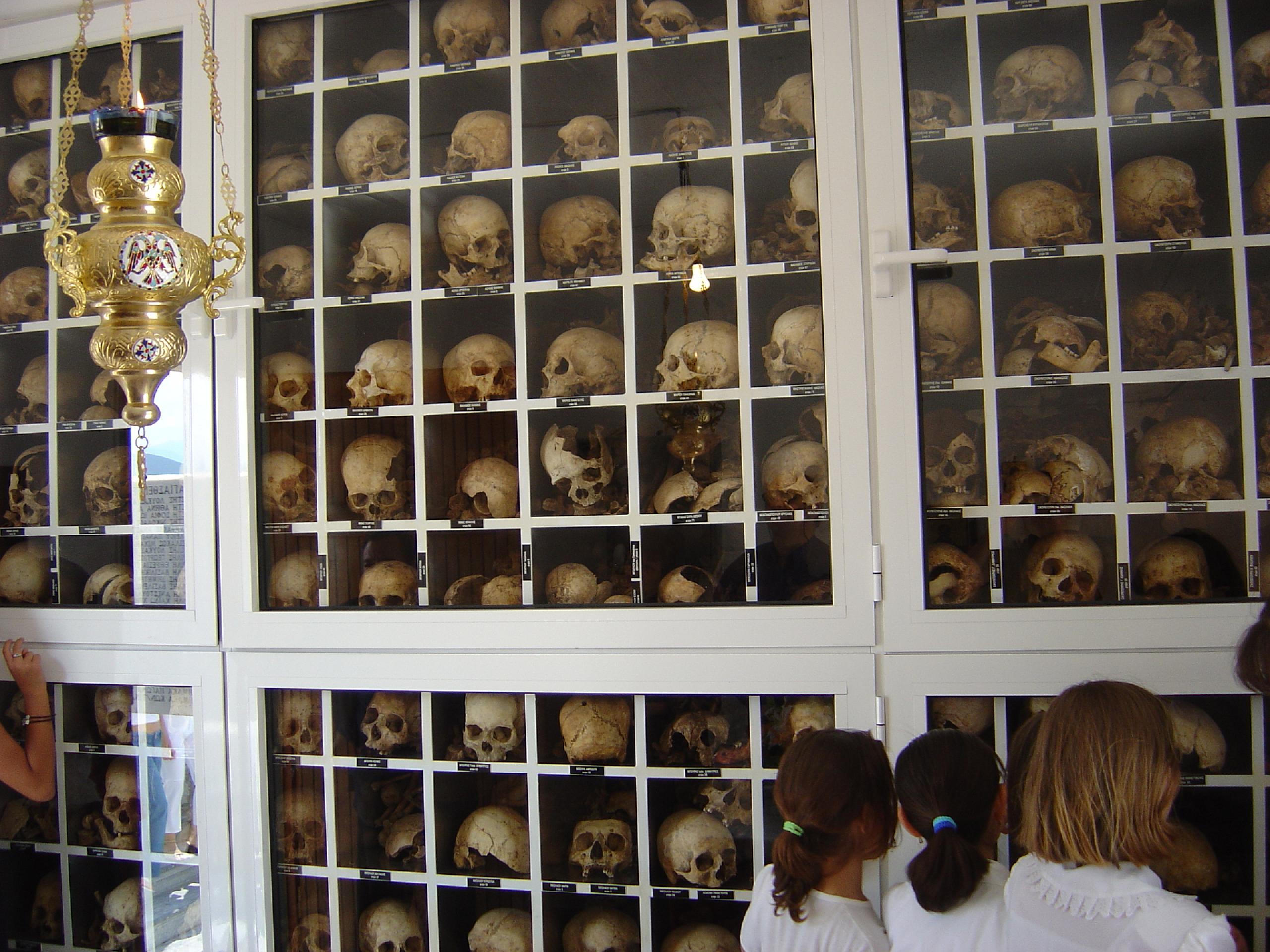
The memorial was erected in the 1980s on a hill overlooking Distomo. A chapel and ossuary, which contains the skulls of the victims, are part of the memorial site. Engraved in a marble wall are the names and ages of the victims. Every year, on June 10, a commemorative ceremony takes place here; the German ambassador to Greece regularly participates in it.
About 10 kilometres to the east, along the road to Athens, another memorial was set up to commemorate the victims of the massacre. It was created by the sculptor Aggelika Korovessi.
In the 1990s, survivors of the massacre and relatives of victims went to court in Greece demanding restitution from the Federal Republic of Germany – the issue created an international stir. Despite a final adjudication by the Greek supreme court, Germany refuses to accept the verdict pointing to state immunity in international law.