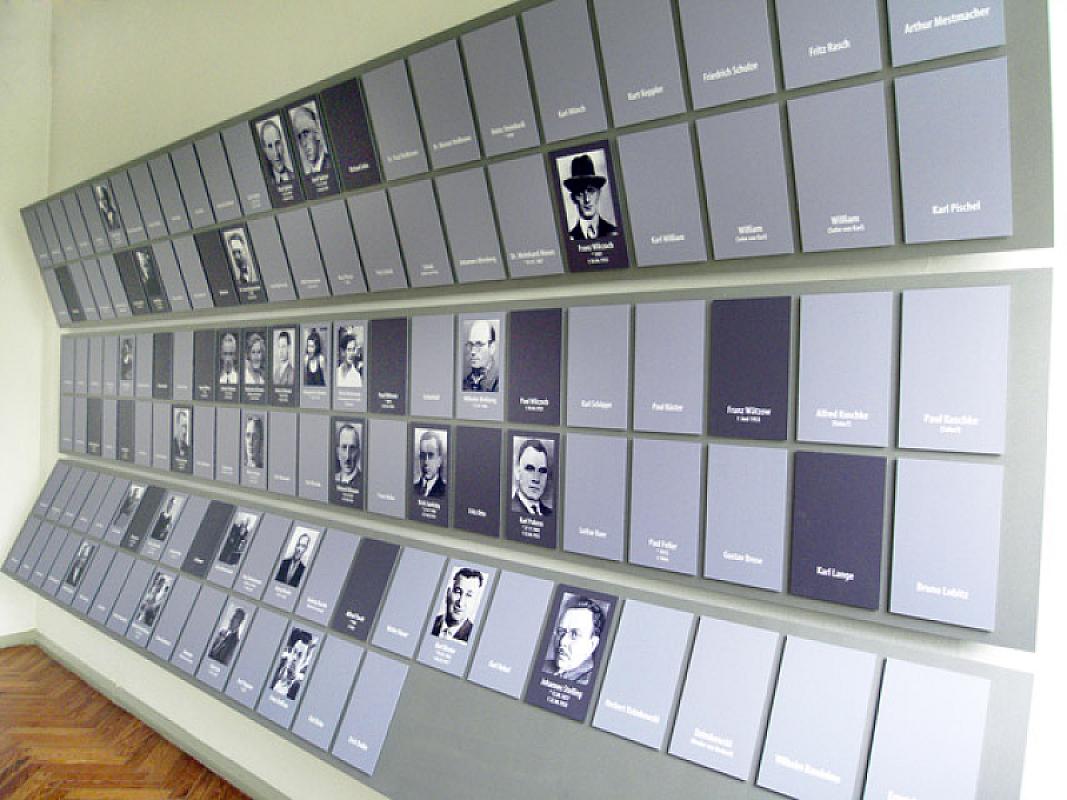
The German Resistance Memorial Center commemorates in its exhibition »Resistance against National Socialism« individuals and groups who stood up to the National Socialist dictatorship between 1933 and 1945.
History
Resistance against National Socialism was much diversified. Men and women from all social backgrounds and political blocs were active in resistance either as individuals or in groups. Among the resistance groups which planned and undertook measures against the National Socialists was, for example, the »Kreisau Circle«, which was a centre of civil resistance.
The »Red Orchestra« was the term the National Socialists used to describe several resistance groups which were active all over Europe and supposedly had contacts to the Soviet Union. The group comprised about 150 men and women.
Oberst Claus Schenk Graf von Stauffenberg, on the other hand, was a leading member of a resistance group consisting of Wehrmacht officers. They planned to assassinate Adolf Hitler and thus put an end to the National Socialist regime. The assassination plot, which Stauffenberg personally took part in on July 20, 1944, failed, as did the attempted coup d'etat. Stauffenberg and other army officers who had been involved in the plotting were executed.


Victims
In the night of July 20/21, 1944, Oberst Claus Schenk Graf von Stauffenberg and three of his accomplices were executed in the courtyard of the Bendler Block by three Wehrmacht officers loyal to the regime. In all, 87 members of the resistance group led by Stauffenberg were executed.
Many members of non-military resistance groups as well as individuals who had undertaken resistance were persecuted by the Gestapo and murdered. Among the most well-known were Hans and Sophie Scholl, who were decapitated in Munich in February 1943 after being tried by the »Volksgerichtshof« (People's Court), but also the blue-collar worker Georg Elser, who, having tried to assassinate Hitler in November 1939 was murdered in the concentration camp Dachau shortly before the end of the war.
Remembrance
The German Resistance Memorial Center is located in the former building of the Army High Command in the Stauffenbergstraße, in the so-called Bendler Block. Oberst Claus Schenk Graf von Stauffenberg's office used to be located in what are today the exhibition rooms.
On July 20, 1953, the mayor of Berlin, Ernst Reuter, unveiled a memorial in the courtyard of the Bendler Block. Prior to that, the Berlin Senate had decided upon remodelling the courtyard into a site of commemoration. Since then, official commemorative ceremonies take place at the memorial annually on July 20. In 1962, a memorial plaque dedicated to the executed officers was set up on the courtyard.
At the end of the 1960s, a memorial and educational centre on the topic of military resistance to National Socialism was opened. The centre has had a permanent exhibition since 1983, which documents the diversity of German resistance against National Socialism. In 1989, the Memorial Center developed a further permanent exhibition entitled »Resistance against National Socialism«. It was replaced in he summer of 2014 by yet a new exhibition of the same name.
Today, the German Resistance Memorial Center is a site of commemoration, documentation, research and civic education. Its mission is to present an overall picture of German resistance.


Possibilities
Permanent exhibition »Resistance to National Socialism«, film screening every first Sunday of the month, publications, loanable travelling exhibition, guided tours available in several languages, seminars centred around various themes
Open
Monday to Wednesday and Friday 9 a.m. to 6 p.m., Thursday 9 a.m. to 8 p.m., Saturday and Sunday 10 a.m. to 6 p.m.
Contact
info@gdw-berlin.de
+49 (0)30 269 950 00
Stauffenbergstraße 13-14
10785 Berlin