Since 2001, a memorial made of bronze figures with commemorative plaques in Corfu's historic town centre has commemorated the deportation of around 1,800 Corfu Jews to the Auschwitz-Birkenau extermination camp in 1944.
History
Corfu is the largest Ionian island with around 100,000 inhabitants. The roots of Jewish history on Corfu go back to the twelfth century. In the 15th century, the Venetian rulers of the island had the now numerous Jews wear labelling and they were only allowed to live in a separate residential district, a so-called ghetto. An influx of Sephardic Jews - who came from Spain - increased the size of the community on Corfu.
Corfu became part of the Kingdom of Greece in 1864. At the end of the 19th century, around 5,000 Jews lived on the island. Rising anti-Semitism and an anti-Jewish pogrom in 1891 caused about half of the Jewish population to emigrate.
During the Second World War, Corfu came under Italian occupation. After Italy switched sides in 1943, the German Wehrmacht conquered the island by force and carried out a massacre against Italian officers. At this time, around 2,000 Jews were still living on the island.
In June 1944, the »Reichssicherheitshauptamt« (RSHA - Reich Main Security Office) had around 1,800 Jews deported from the old town of Corfu, firstly to Athens. There they were initially held in the Chaidari concentration camp for a month before being deported to the Auschwitz-Birkenau extermination camp. The majority of the Jews deported to Auschwitz-Birkenau were suffocated with poison gas immediately upon arrival, while the others were forced to perform forced labour.
It is estimated that around 200 Jews from Corfu managed to hide outside the city on the island and thus survive.
Victims
Of the approximately 1,800 Jews deported from Corfu, only around 50 returned to the island. Most of the survivors emigrated, mainly to Palestine (Israel from 1948).
Today's Jewish community on Corfu has around sixty members.
The Wehrmacht invaded the Kingdom of Greece in April 1941. The country was divided up between the Third Reich and its Axis allies Italy and Bulgaria. The occupying powers exploited Greece’s agricultural resources as well as the country’s limited industrial capacity. This resulted in a famine in the winter of 1941-42, which probably claimed the lives of over 100,000 Greeks. Jewish life in occupied Greece was dominated by expropriation, public abuse, arrests, murder and forced labour. Between March 15 and mid-August 1943, around 46,000 Jews were deported in 19 transports from Thessaloniki to the Auschwitz-Birkenau and Treblinka extermination camps. These transports were organised by an SS special commando with the support of the local military administration. At the beginning of March 1943, the Bulgarian occupation authorities in the Greek province of Thrace had already arrested over 4,000 Jews, who were subsequently deported to Treblinka by the SS. Following the capitulation of Italy in autumn 1943, the Wehrmacht advanced to the Italian-occupied part of Greece. In March 1944, the SS and locals deported over 8,500 Jews from Athens, Ionnina and Rhodes to Auschwitz-Birkenau. Italy had previously refused to deport these Jews. Around 59,000 Greek Jews were murdered in the Holocaust.
The German occupation regime met with growing Greek resistance. The Wehrmacht responded in 1943-44 with numerous brutal attacks, reprisals and mass shootings. Entire villages were destroyed, for example the villages of Kalavrita and Distimo. Over 100,000 Greek civilians are believed to have died in the process.
The period from 1944, whilst Greece was still occupied by Germany, saw conflict between right-wing royalists and left-wing communist groups in the country. These conflicts escalated into a civil war from 1946-49. The royalists won this war with the support of Great Britain and the USA and adopted a strict anti-communist approach. Faced with a likely left-wing election victory in 1967, the military staged a putsch, seized power, and governed the country for the next seven years. The left-wing’s role in the resistance during the Second World War was only acknowledged following Greek accession to the European Economic Community in 1981. With the fall of communism in 1990-91 the divisions in Greek memory were finally overcome, allowing a confrontation with the 1946-49 civil war.
To a large extent, the Greek culture of memory continues to be dominated by remembrance of the resistance against the Germans. Memorial inscriptions often use the term »Holocaust« to refer to the murder of the civilian population, for example the »Holocaust of Kalavrita«. For a long time it was left to the Jewish community to remember the 85 percent of Greek Jews who were murdered in the Holocaust. Until 1997, the country’s only Holocaust memorial was to be found in the Jewish cemetery in Thessaloniki, the town with the largest Jewish community in Greece before the war. A Holocaust memorial was inaugurated in the centre of Saloniki in 1997 in conjunction with the ceremonies marking the town’s status as European City of Culture that year. In 2005, the memorial was moved to another site in the city. In 2010, a new holocaust memorial was inaugurated in Athens as well. Currently, a major holocaust museum is under construction in Thessaloniki, to which Germany contributes a sum of 10 million euros.
Remembrance
The deportations from Corfu were coordinated by SS-Obersturmführer Anton Burger, who was head of the ‘Jewish Department’ of the RSHA in Athens at the time. Burger was able to evade justice by fleeing and using various identities and was only exposed after his death in 1991.
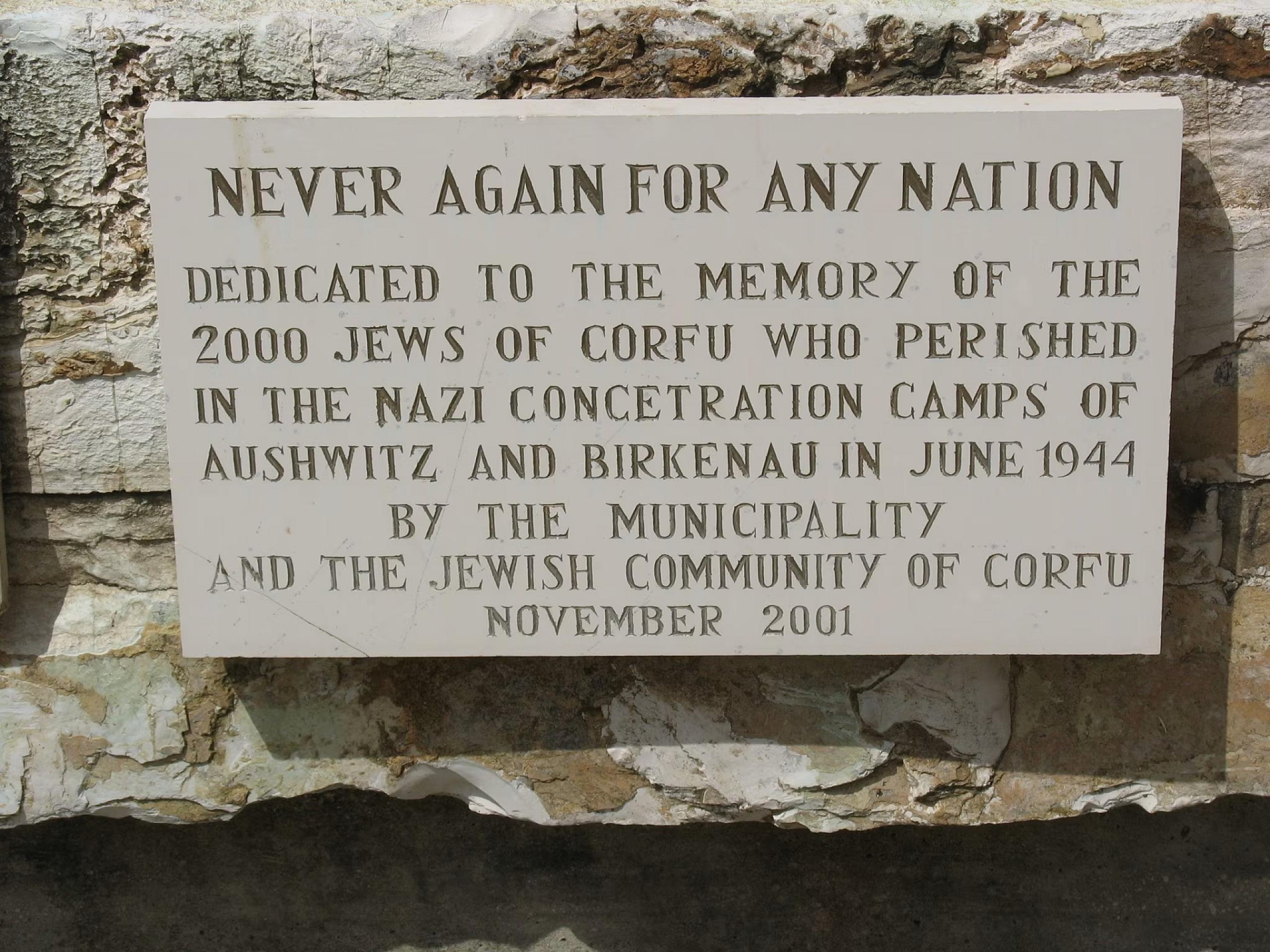
In 2001, a memorial to the deported Jews was unveiled in the historic centre of Corfu. It was donated jointly by the city council and the Jewish community of Corfu. The bronze sculpture, designed by sculptor Georgios Karahalios, depicts two adults, a standing child and one being carried by the woman. The figures stand on a natural stone plinth. Two plaques are attached to it with the following inscription in Greek and English: »Never again for any nation. Dedicated to the memory of the 2,000 Jews of Corfu who died in the Nazi concetration [sic!] camps Aushwitz [sic!] and Birkenau in June 1944«.
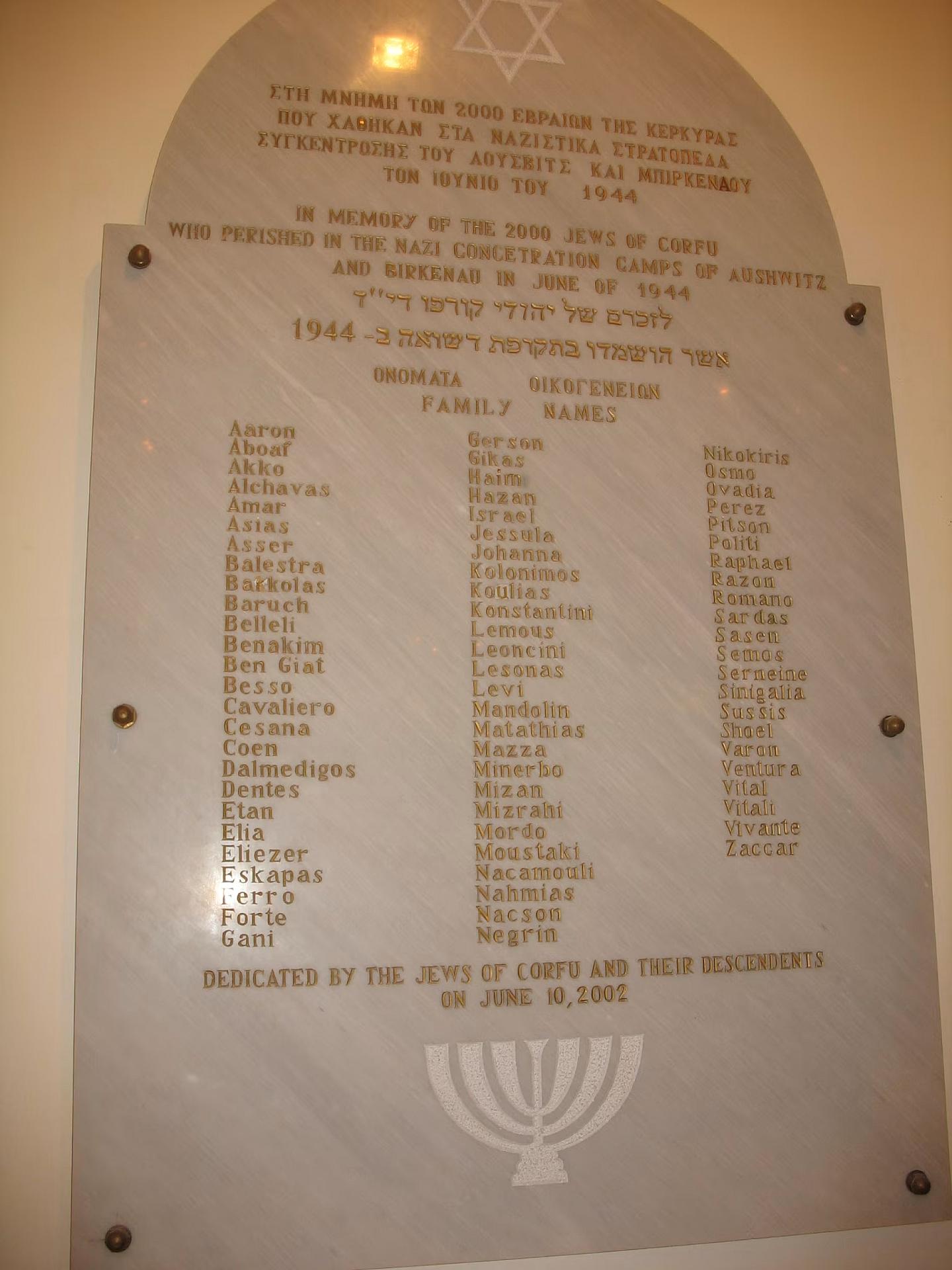
Not far from the memorial is the synagogue, where a memorial plaque has been hanging since 2022, showing numerous family names of those deported in 1944.
Open
The memorial is accessible at all times.
The memorial plaque in the synagogue is only accessible during the synagogue's opening hours (Mon-Sat 10.00 to 16.00).
Contact
Holocaust-Denkmal von Korfu
Str. Xenofontos
Kerkira 491 00
Griechenland
Synagoge von Korfu
Velissariou 24
Kerkira 491 00
Griechenland