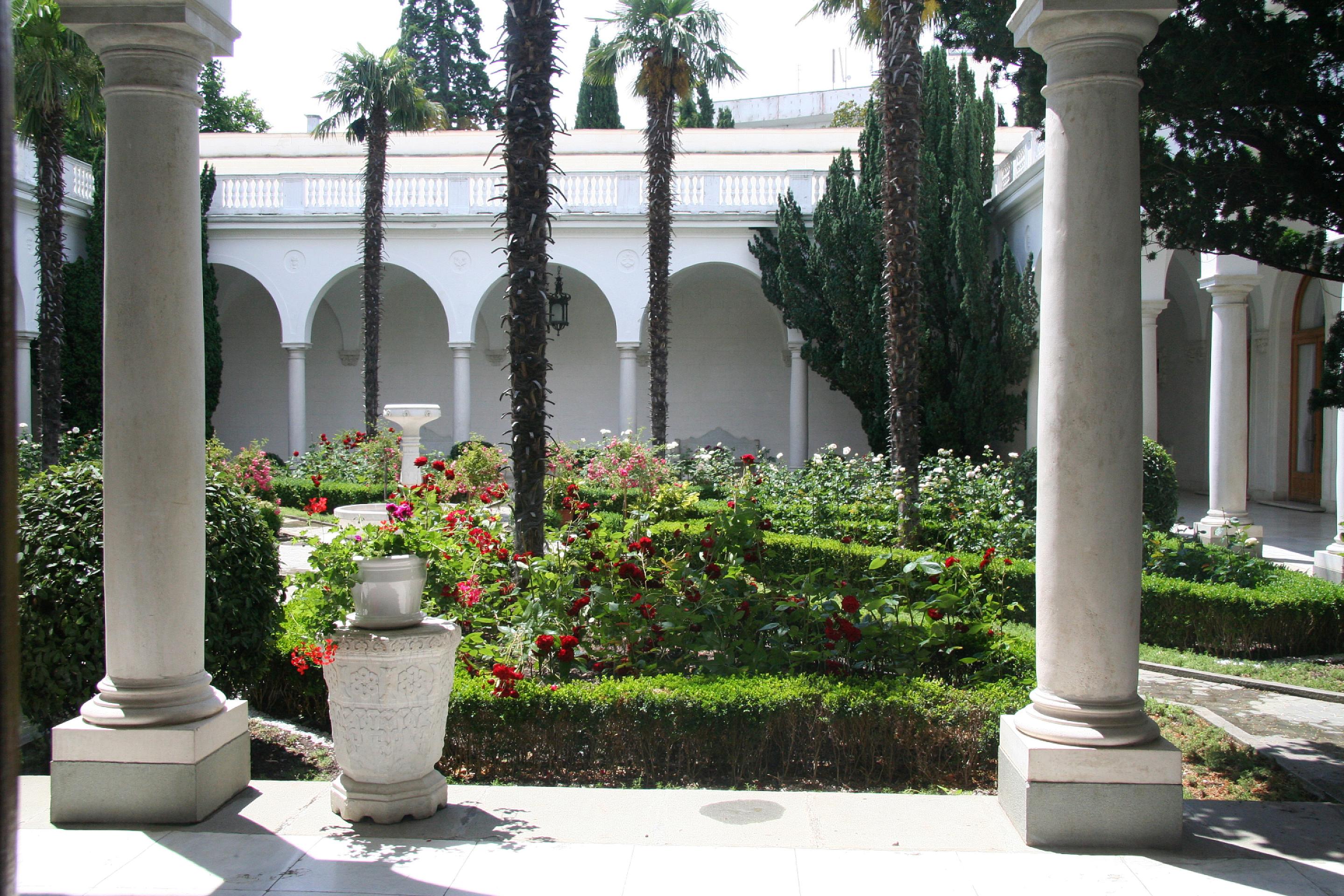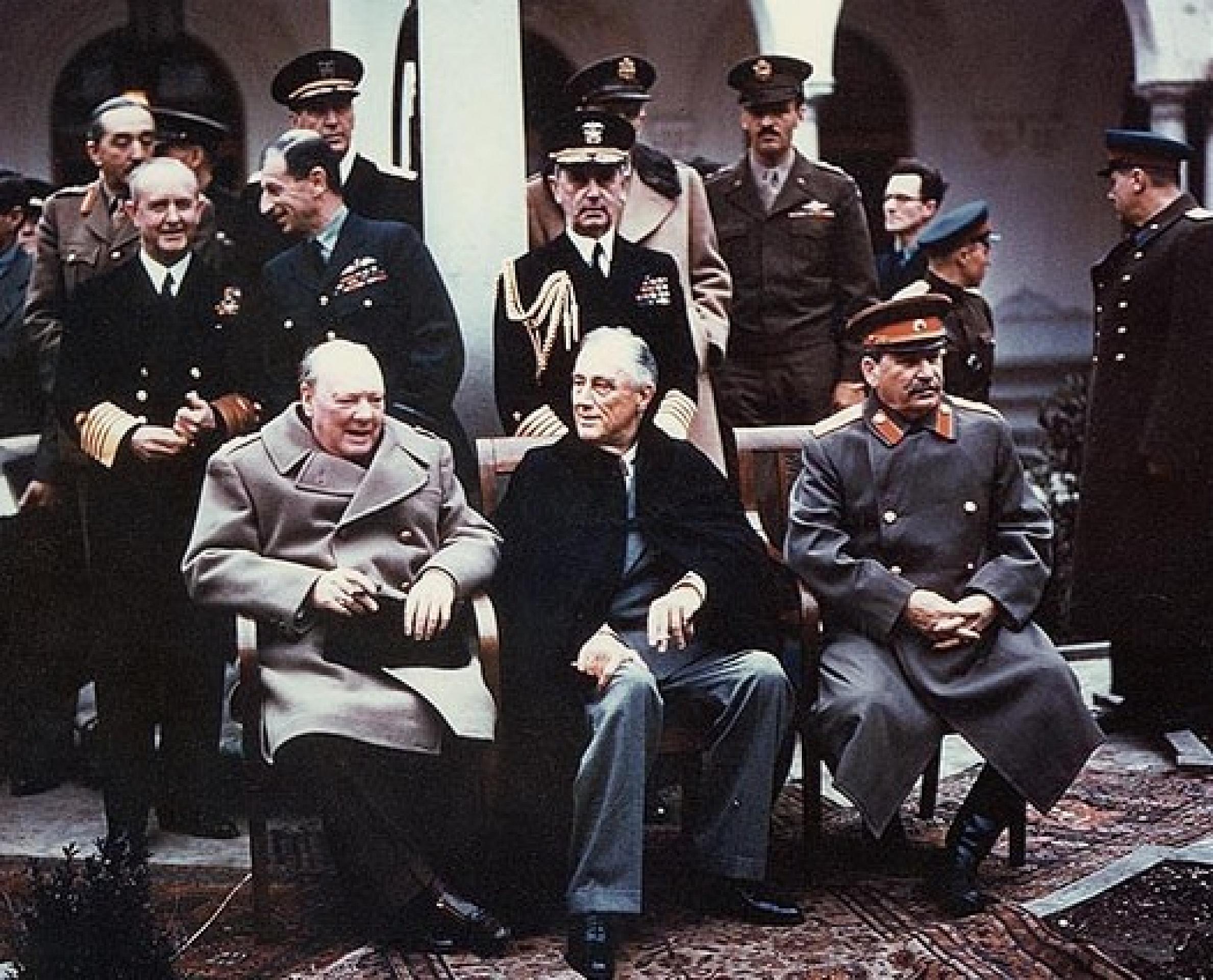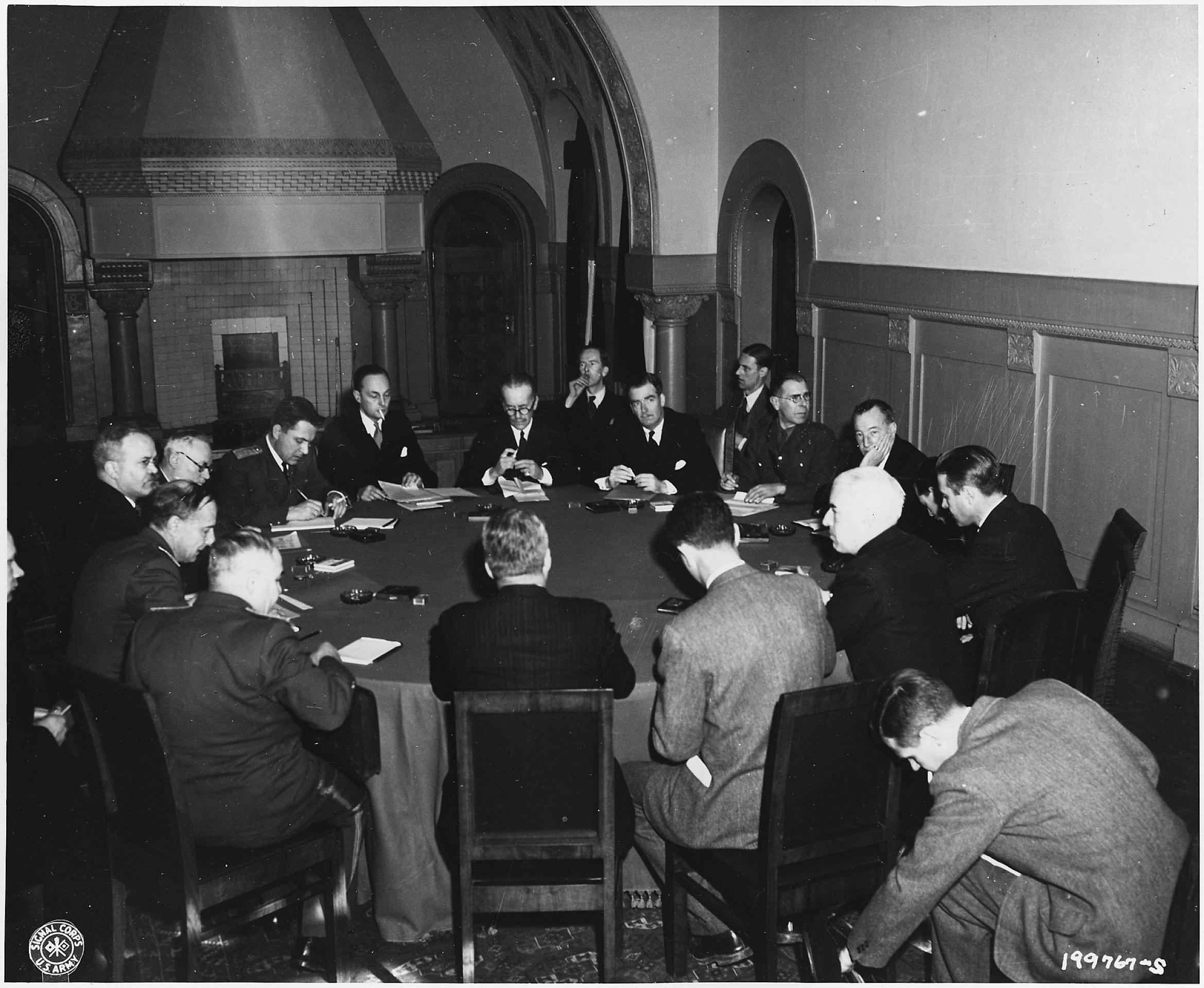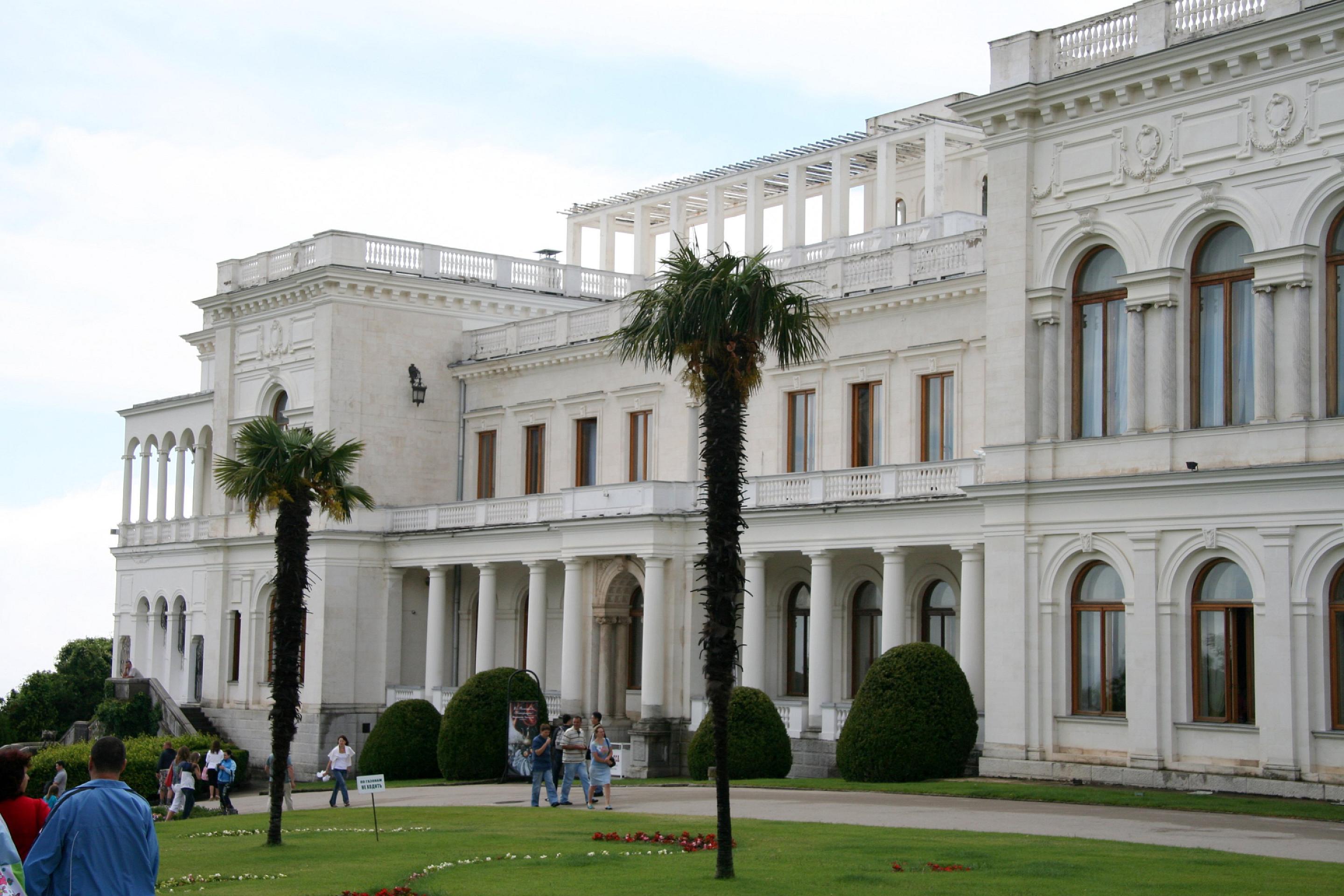
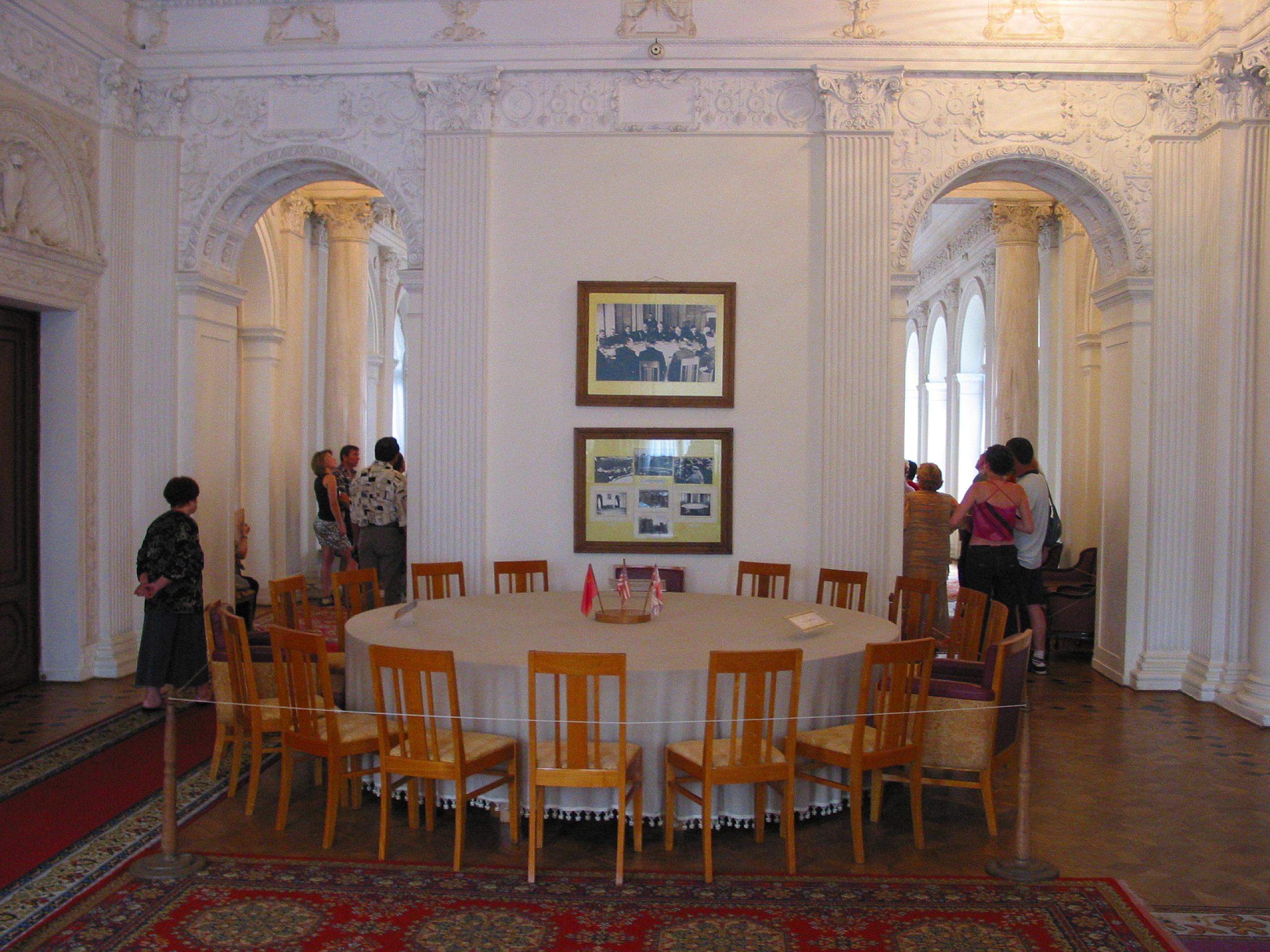
A museum in the Livadia Palace in the coastal resort of Yalta in Crimea remembers the allied conference which took place in February 1945 for the purpose of discussing Europe's post-war reorganization.
History
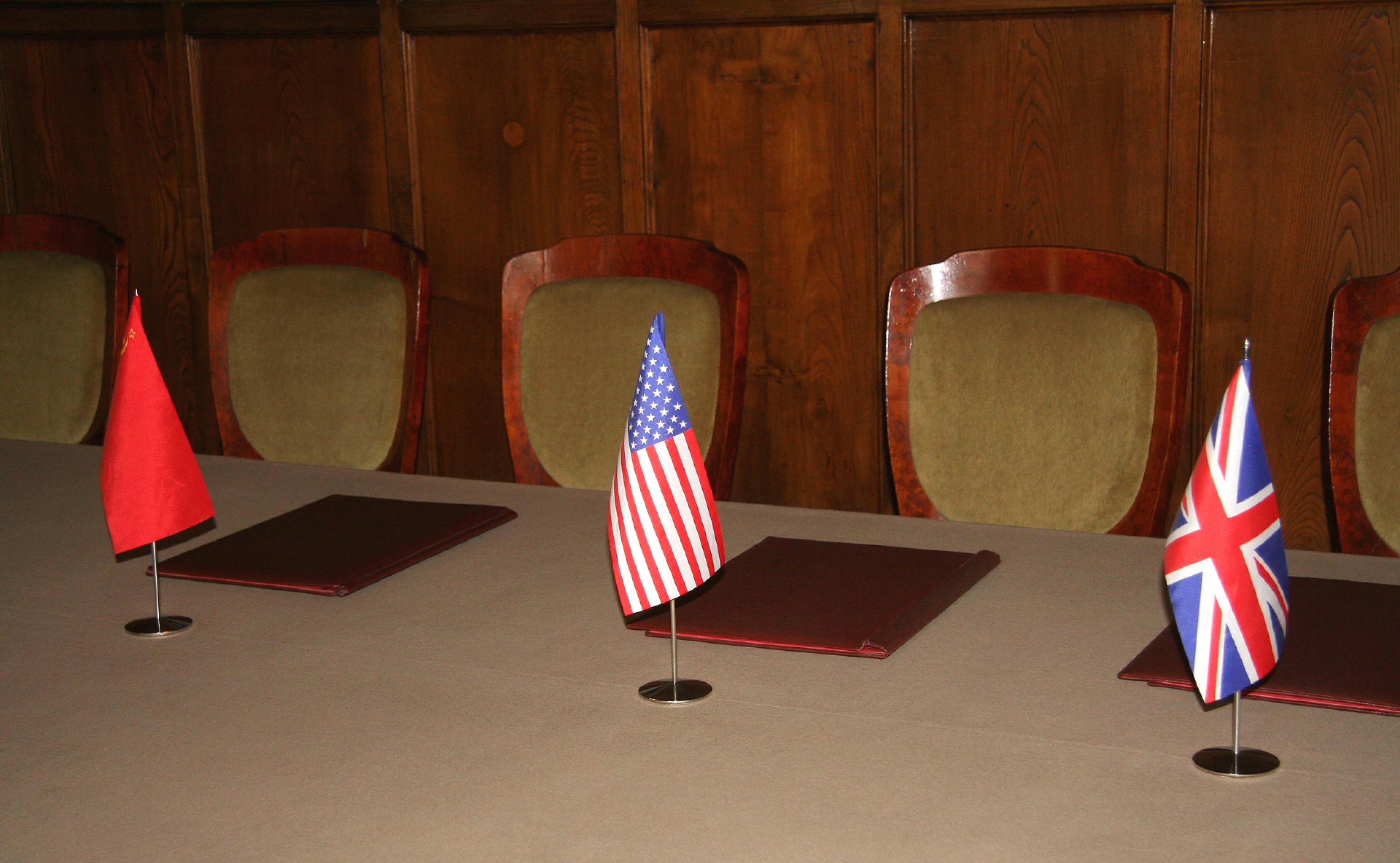
After the USA entered the war in 1941 and the looming German defeat after the turning-point of war in winter 1942/43, the heads of government of the main Allies USA, Great Britain and Soviet Union met at several conferences from 1943 on. At these meetings first and foremost the post war status of Germany and the Eastern European states was discussed. The second of these summits took place on Soviet territory, in the coastal resort of Yalta in Crimea. From February 4 – 11, 1945 the heads of state and government Winston Churchill, Franklin D. Roosevelt and Joseph Stalin met at the Livadia Palace in Yalta, the former summer residence of the last Russian tsar. There the Allies decided principally to divide Germany after the war but didn't yet agree on borders. Most important topic on the agenda was Poland's future: The Allies adopted the shift of the Polish border to the West following the Curzon Line. This line from Hrodna (polish: Grodno) via Brest to Przemyśl had already been suggested as the Eastern border of Poland in 1919. Poland would receive territorial compensation in the North and West at the expense of the German Reich. Moreover, Churchill, Roosevelt and Stalin agreed on the founding of the United Nations and the Soviet Union agreed to enter the fight against Japan after the German capitulation. Although the interests of the three powers were too diverse to bring about concrete results regarding Europe's territorial reorganization, the negotiations boiled down to the Soviet Union trying to maintain and expand its influence on Eastern Europe.
Victims
The Yalta Conference of 1945 served to develop the principles for the reorganization of the European states after the end of World War II. Although no concrete resolutions were adopted, the conference nevertheless laid the foundation of further developments, such as the westward shift of Poland's border and the expulsion of millions of Germans from former Eastern territories as well as the relocation of millions of Poles from today's Ukraine. It also became apparent that the Soviet Union would bring the occupied Eastern European countries under its influence.
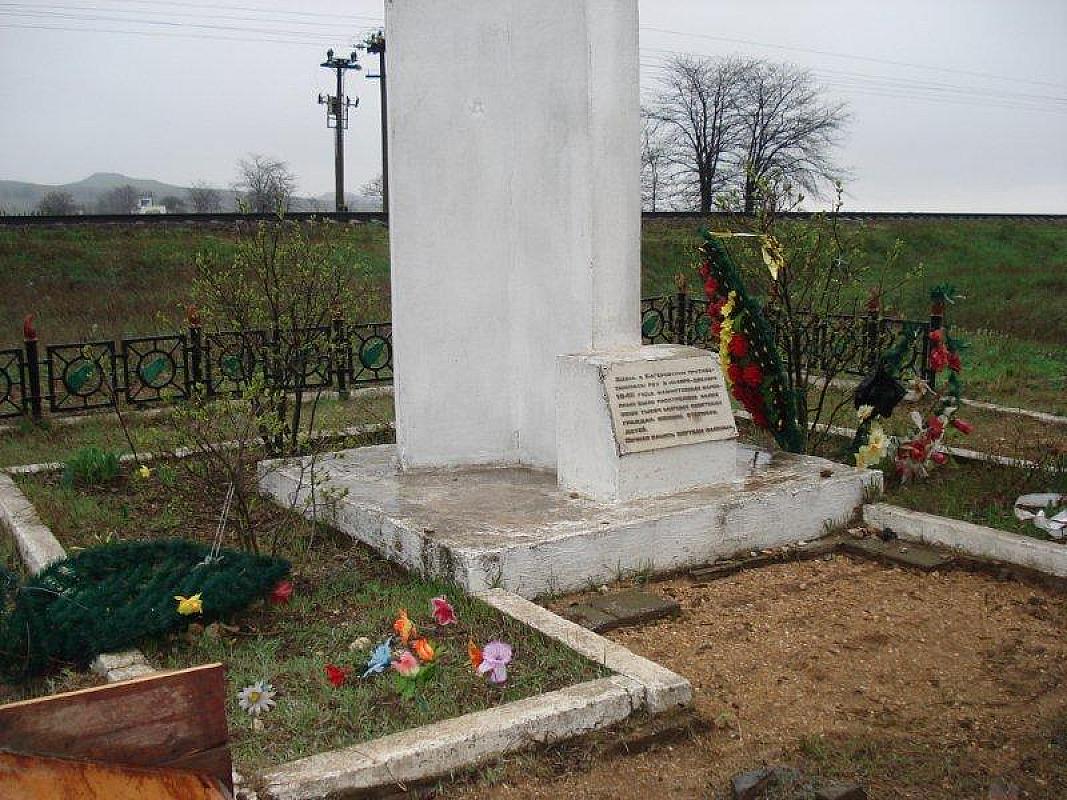
Ukraine, the second-largest Republic in the European part of the former Soviet Union, was at the centre of the Second World War and the Holocaust. It is estimated that five to six million Ukrainians died during the war, including around 630,000 Jews.
In mid-September 1939, following the Soviet occupation of eastern Poland in accordance with the Hitler-Stalin Pact – a secret German-Soviet agreement –, the south-east of Poland became part of the Soviet Ukraine. The oppression of the local population was now an everyday occurrence. In summer 1941, the German attack on the Soviet Union initially affected these very regions. Right from the start of the invasion the Jewish population was accused of supporting the Soviet powers and became the target of brutal attacks. These attacks were often the work of nationalist Ukrainians, who initially welcomed the advance of the Wehrmacht. German SS Einsatzgruppen and allied Rumanian units soon began to carry out mass shootings of Jews. The Babyn Yar ravine near Kiev, where German units and Ukrainian militia murdered over 33,700 Jews over two days in September 1941, has since become a global symbol of the genocide of Jews. The non-Jewish population was also a target for persecution. National Socialist racist ideology classed Ukrainians, as all »Slavs«, as »subhuman«. The occupiers looted the country, deported way over one million civilians to carry out forced labour and publicly executed hostages. By 1943 a partisan war against the Wehrmacht was raging along with the campaign of the nationalist »Ukrayinska Povstanska Armiya« (Ukrainian Rebel Army or UPA) against the Soviets and the Polish population in western Ukraine. The number of Poles to die in the process lies way over 100,000. From 1944 the Ukraine was again part of the Soviet Union and also encompassed former territories in eastern Poland. The UPA continued its campaign until the mid-1950s. The Soviet authorities deported around 300,000 Ukrainians to Siberia to counter the resistance.
The Ukrainian culture of memory was aligned with the symbolic forms of remembrance found in the Soviet Union. Monumental sites of memory were constructed to celebrate the »victory« in the Great Patriotic War. It is only recently that victims have been remembered alongside the venerated heroes. In addition, a culture of memory centred on the campaign of the UPA has emerged in western Ukraine, with the UPA’s legacy being interpreted as a struggle for independence. Confrontation with anti-semitism and the collaboration with the German occupiers has only begun around 2000. With just a few exceptions, the mass shootings of Jews were ignored until the 1980s. It was not until 1991 that the government of independent Ukraine acknowledged Babyn Yar as a »symbol of Jewish martyrdom«. Long after gaining independence, Ukraine was still on the search for its national identity. The documentation of Soviet crimes – for example the state’s responsibility for the Great Famine (Holodomor) in 1922-23 that led to millions of deaths – has more significance in the establishment of a Ukrainian identity than learning about the Holocaust. Nevertheless, new memorial sites for the murdered Jews were established throughout the country, such as Drobitskiy Yar in Kharkiv or the Holocaust Museum in Odessa. On many mass grave sites new memorials were created, partially with German support. In Kiev, a new grand memorial site with global relevance was planned at Babyn Yar. These plans were put on hold with the beginning of the full-scale Russian invasion of Ukraine on February 24, 2022. What impact the current defensive war will have on Holocaust remembrance in the future remains to be seen.
Remembrance
A first summer retreat for the Russian royal family was built in 1862 in Yalta or, to be more precise, in the suburb of Livadia. After the building had to be demolished because of severe groundwater damage, Tsar Nicholas II (1868 – 1918) had today's »White Palace« built in 1910.
In 1974 US president Nixon wanted to see the venue of the Yalta Conference during his official state visit to the Soviet Union. On this occasion a museum was established on the ground floor of the Livadia Palace, dedicated to the 1945 conference. In independent Ukraine after the collapse of the Soviet Union the upper floor with the former tsar's chambers were made accessible to the public. After the illegal Russian annexation of the Crimean Peninsula, the museum is still open. It is regularly host to special exhibitions and events with reference to the Yalta Conference, but also to the history of both world wars and to the Romanov dynasty.
Possibilities
Permanent exhibitions, conference rooms, libraries, park, temporary exhibitions